The Universe's Origin: Cosmology
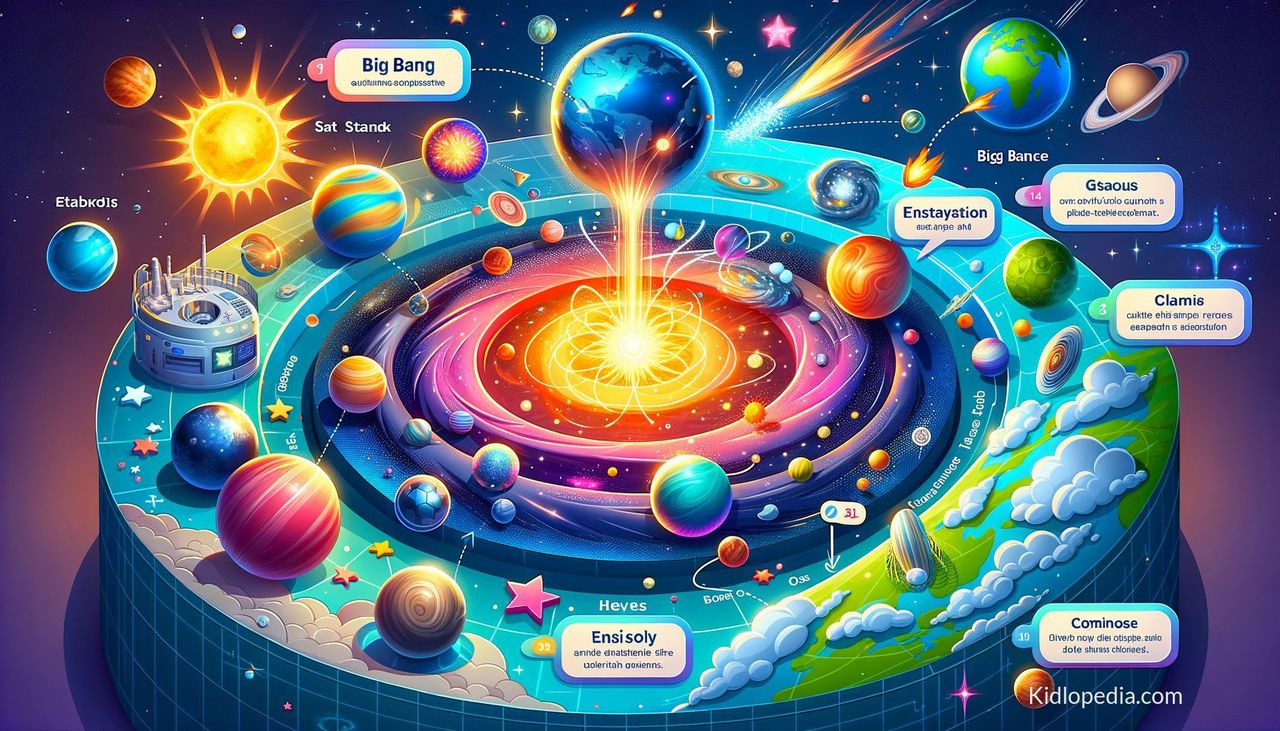
Cosmology is the scientific study of the universe's origin, evolution, and eventual fate. It explores how the universe began, including theories like the Big Bang, which suggests that the universe started as a small point that expanded rapidly about 13.8 billion years ago. Understanding cosmology helps us learn about the nature of space, time, and the physical laws that govern everything around us.
Cosmology is the scientific study of the universe's origin, evolution, and eventual fate.
It helps us understand how everything around us, including stars and galaxies, came to be.
Scientists use observations and experiments to explore the universe's beginnings and how it changes over time.
One of the most important ideas in cosmology is the Big Bang Theory.
This theory suggests that the universe started as an extremely small point.
About 13.8 billion years ago, this small point expanded very quickly.
This expansion created space and time as we know them.
It generated all the matter and energy that would form stars, planets, and galaxies.
After the Big Bang, the universe began to cool down.
As it cooled, particles combined to form atoms.
These atoms eventually grouped together to create stars and galaxies.
Over billions of years, stars lived and died, creating new elements and forming the planets we see today.
Cosmology also studies the future of the universe.
Scientists explore various outcomes, such as if the universe will keep expanding forever or if it will eventually contract back into a small point.
These ideas help us understand not just our own planet, but where everything fits in the vast universe.
Did you know?
The universe is so large that it is still growing! Every day, galaxies move farther away from each other.
Also, the universe is not uniform; it contains both matter and mysterious energy that scientists are still trying to understand.
You can learn more topics like this at Kidlopedia.com.
It helps us understand how everything around us, including stars and galaxies, came to be.
Scientists use observations and experiments to explore the universe's beginnings and how it changes over time.
One of the most important ideas in cosmology is the Big Bang Theory.
This theory suggests that the universe started as an extremely small point.
About 13.8 billion years ago, this small point expanded very quickly.
This expansion created space and time as we know them.
It generated all the matter and energy that would form stars, planets, and galaxies.
After the Big Bang, the universe began to cool down.
As it cooled, particles combined to form atoms.
These atoms eventually grouped together to create stars and galaxies.
Over billions of years, stars lived and died, creating new elements and forming the planets we see today.
Cosmology also studies the future of the universe.
Scientists explore various outcomes, such as if the universe will keep expanding forever or if it will eventually contract back into a small point.
These ideas help us understand not just our own planet, but where everything fits in the vast universe.
Did you know?
The universe is so large that it is still growing! Every day, galaxies move farther away from each other.
Also, the universe is not uniform; it contains both matter and mysterious energy that scientists are still trying to understand.
You can learn more topics like this at Kidlopedia.com.