The Cosmic Giants: Black Holes
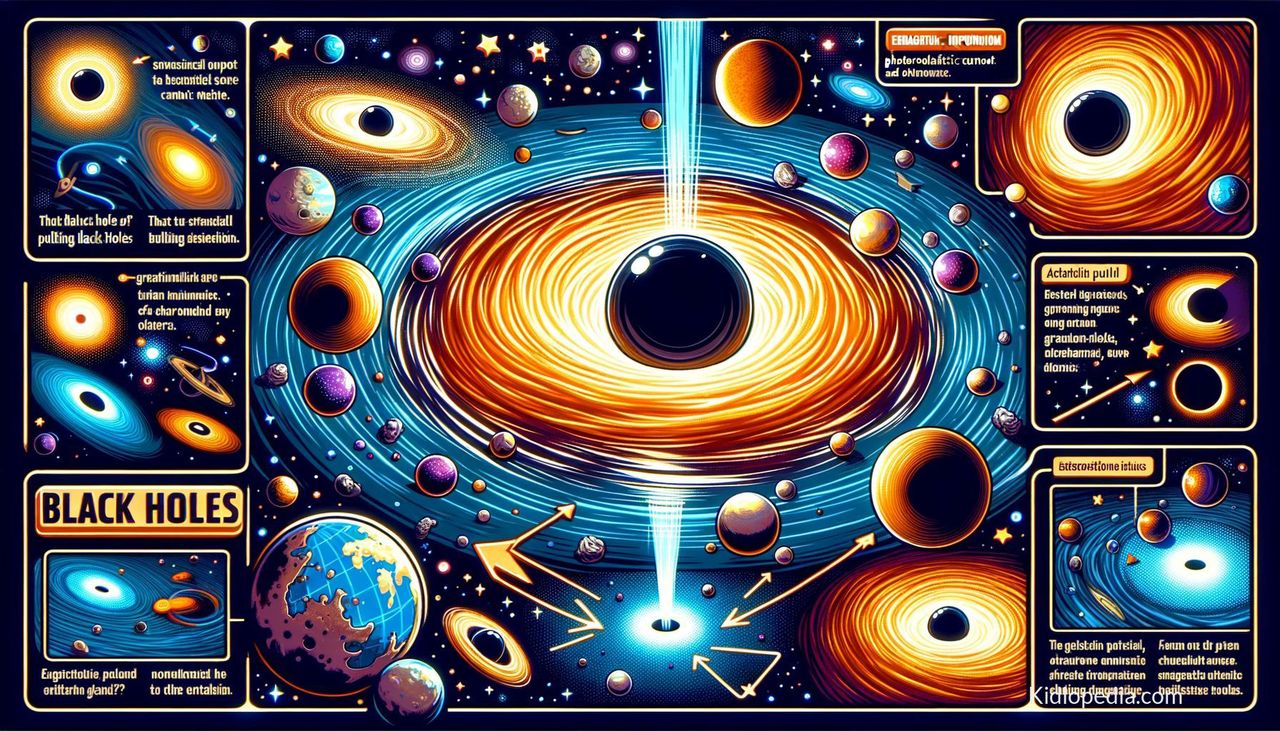

Black holes are regions in space where gravity is so strong that nothing, not even light, can escape from them. They form when very large stars exhaust their fuel and collapse under their own gravity. Studying black holes helps scientists learn more about the universe and the fundamental nature of space and time.
Black holes are regions in space where gravity is so strong that nothing, not even light, can escape from them.
This makes them invisible to the eye, which is why they are called “black.” They form when very large stars run out of fuel and collapse under their own gravity.
When a massive star reaches the end of its life, it goes through a process called supernova, which is a powerful explosion.
After the explosion, if the remaining core of the star is heavy enough, it can collapse into a black hole.
The core's gravity becomes incredibly strong, pulling everything nearby, including light, into it.
The area around a black hole is known as the event horizon.
This is the boundary beyond which nothing can escape its gravitational pull.
Once something crosses this line, it cannot return.
Imagine trying to climb back out of a deep hole; once you fall in, it is very hard to get back out.
Black holes come in different sizes.
Some are just a few times heavier than the sun, while others, called supermassive black holes, can be millions or even billions of times the sun's mass.
Supermassive black holes are often found at the center of galaxies, including our own Milky Way galaxy.
Scientists study black holes to learn more about the universe and the laws of physics.
They help us understand how space and time work.
Even though black holes may sound scary, they play an important role in the cosmos.
Did you know that the closest known black hole to Earth is about 1,000 light years away?
Also, it is believed that every large galaxy has a supermassive black hole at its center!
If you want to discover more amazing facts about space, visit Kidlopedia.com!
This makes them invisible to the eye, which is why they are called “black.” They form when very large stars run out of fuel and collapse under their own gravity.
When a massive star reaches the end of its life, it goes through a process called supernova, which is a powerful explosion.
After the explosion, if the remaining core of the star is heavy enough, it can collapse into a black hole.
The core's gravity becomes incredibly strong, pulling everything nearby, including light, into it.
The area around a black hole is known as the event horizon.
This is the boundary beyond which nothing can escape its gravitational pull.
Once something crosses this line, it cannot return.
Imagine trying to climb back out of a deep hole; once you fall in, it is very hard to get back out.
Black holes come in different sizes.
Some are just a few times heavier than the sun, while others, called supermassive black holes, can be millions or even billions of times the sun's mass.
Supermassive black holes are often found at the center of galaxies, including our own Milky Way galaxy.
Scientists study black holes to learn more about the universe and the laws of physics.
They help us understand how space and time work.
Even though black holes may sound scary, they play an important role in the cosmos.
Did you know that the closest known black hole to Earth is about 1,000 light years away?
Also, it is believed that every large galaxy has a supermassive black hole at its center!
If you want to discover more amazing facts about space, visit Kidlopedia.com!