The Universe's Mass: The Higgs Boson
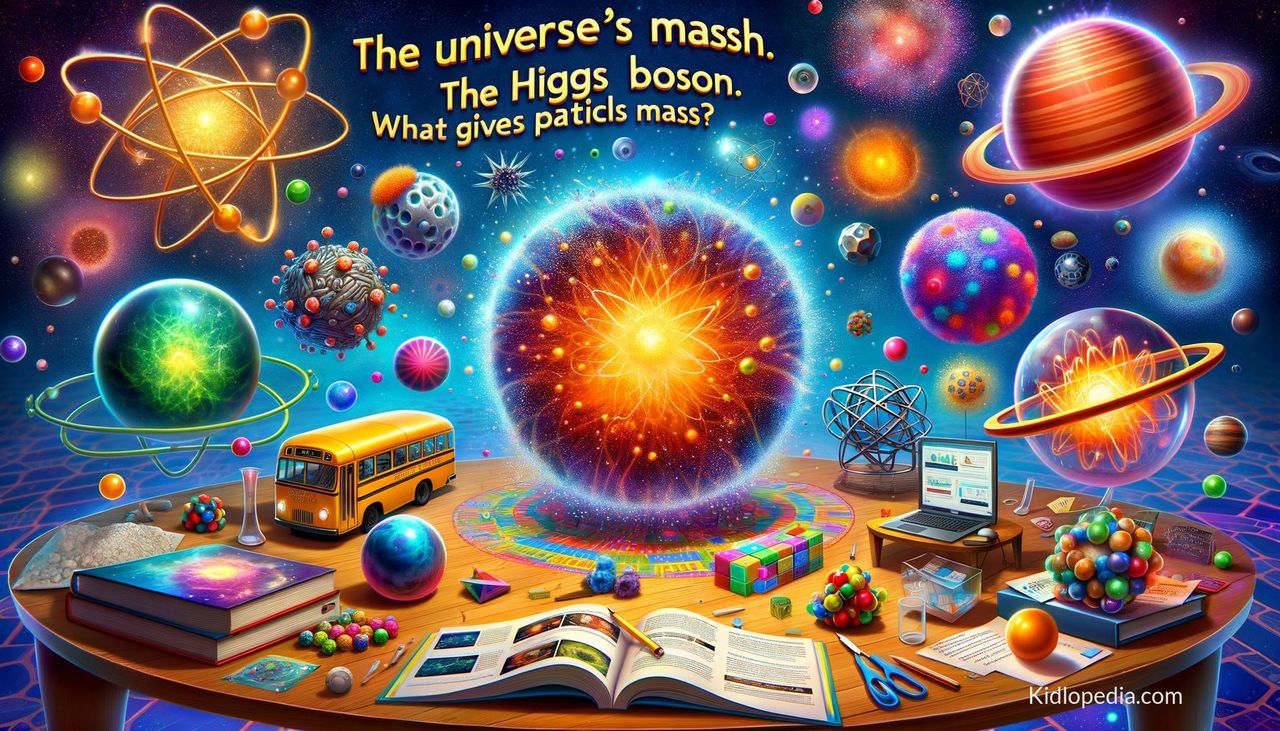

The Higgs boson is a fundamental particle in physics that helps explain how other particles gain mass. It is associated with the Higgs field, a field that exists throughout the universe, which interacts with particles to give them weight. Understanding the Higgs boson is important because it helps scientists learn more about the basic building blocks of everything around us.
The Higgs boson is a fundamental particle in physics that plays a crucial role in how other particles gain mass.
It is a small piece of matter that scientists discovered to help explain why things in the universe have weight.
The Higgs boson is connected to a special field called the Higgs field, which exists everywhere, even in empty space.
When particles move through the Higgs field, they can interact with it.
This interaction is what gives particles their mass.
Think of the Higgs field like a thick syrup.
When particles move through it, they experience resistance, which makes them heavier, just as moving through syrup is harder than moving through air.
Some particles feel this resistance more than others, which is why they have different amounts of mass.
The discovery of the Higgs boson was a significant achievement in science.
Scientists used large machines, called particle accelerators, to find it.
These machines smash particles together at very high speeds.
When this happens, new particles can form, including the Higgs boson.
By studying the Higgs boson, scientists can learn more about the building blocks of everything in the universe.
Understanding the Higgs boson also helps explain why the universe is the way it is.
If particles did not gain mass from the Higgs field, they would not clump together to form stars, planets, or even people.
In this way, the Higgs boson is important for life as we know it.
Did you know?
The Higgs boson was discovered in 2012, and it is often called the “God particle” because it helps explain how our universe works.
Scientists continue to study it to unlock more mysteries of physics!
Learn more about fascinating topics at Kidlopedia.com!
It is a small piece of matter that scientists discovered to help explain why things in the universe have weight.
The Higgs boson is connected to a special field called the Higgs field, which exists everywhere, even in empty space.
When particles move through the Higgs field, they can interact with it.
This interaction is what gives particles their mass.
Think of the Higgs field like a thick syrup.
When particles move through it, they experience resistance, which makes them heavier, just as moving through syrup is harder than moving through air.
Some particles feel this resistance more than others, which is why they have different amounts of mass.
The discovery of the Higgs boson was a significant achievement in science.
Scientists used large machines, called particle accelerators, to find it.
These machines smash particles together at very high speeds.
When this happens, new particles can form, including the Higgs boson.
By studying the Higgs boson, scientists can learn more about the building blocks of everything in the universe.
Understanding the Higgs boson also helps explain why the universe is the way it is.
If particles did not gain mass from the Higgs field, they would not clump together to form stars, planets, or even people.
In this way, the Higgs boson is important for life as we know it.
Did you know?
The Higgs boson was discovered in 2012, and it is often called the “God particle” because it helps explain how our universe works.
Scientists continue to study it to unlock more mysteries of physics!
Learn more about fascinating topics at Kidlopedia.com!