Our Galaxy: The Milky Way
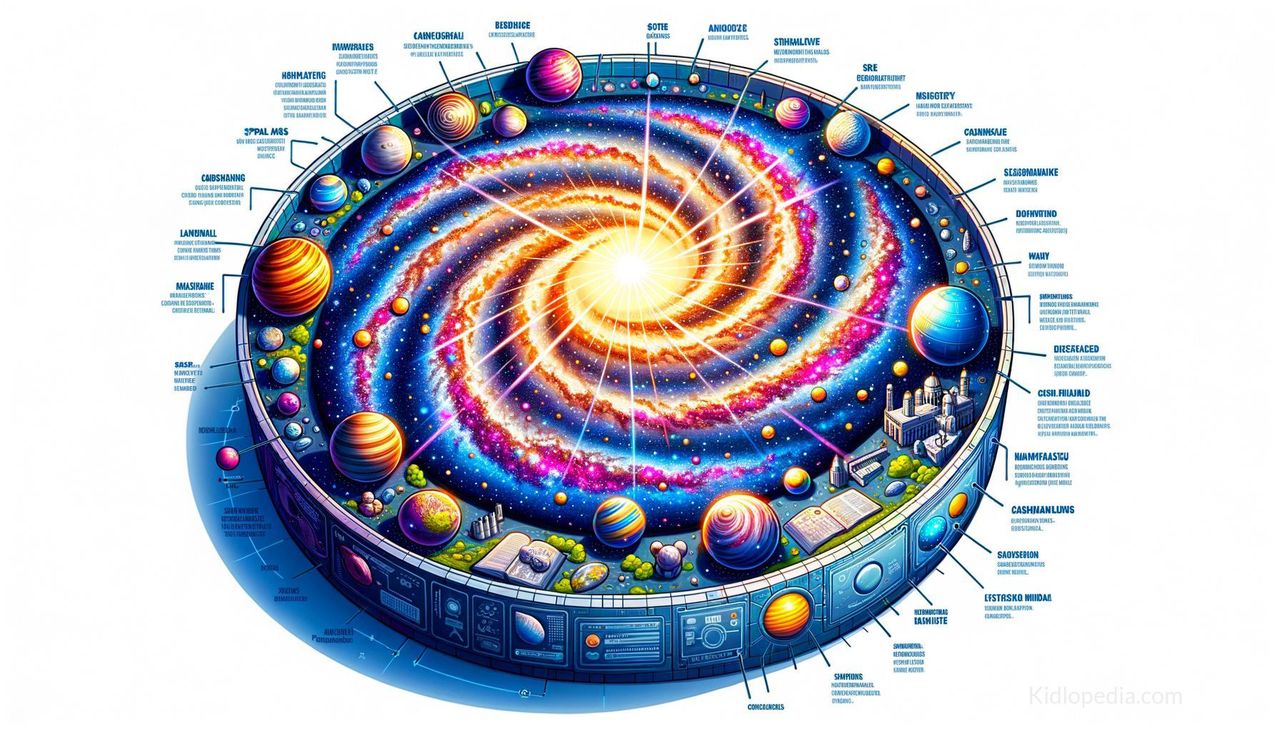
The Milky Way is a galaxy that contains billions of stars, planets, moons, and other space objects. It has a spiral shape, looking like a giant, twirling pancake made of stars, with arms extending outwards. Understanding the Milky Way helps us learn about our universe and our place within it.
The Milky Way is a galaxy that contains billions of stars, planets, moons, and other space objects.
It has a spiral shape, which looks like a giant, twirling pancake made of stars.
The Milky Way is approximately 100,000 light-years wide and is home to our solar system, which includes Earth.
Understanding the Milky Way helps scientists learn more about our universe and our place within it.
The Milky Way is structured in several parts.
The center is called the galactic core, which is very bright and contains many stars.
Surrounding the core are spiral arms that extend outward.
These arms contain most of the stars and planets.
Our solar system is located in one of these arms, known as the Orion Arm.
Stars in the Milky Way are not evenly distributed.
There are areas where many stars are grouped together, while other areas have fewer stars.
The spaces between the stars also contain gas and dust, which can form new stars and planets over time.
The Milky Way is always moving.
Stars, including our sun, orbit around the center of the galaxy.
This movement takes a long time; it can take millions of years for a star to complete one orbit.
Did you know that the Milky Way is just one of billions of galaxies in the universe?
Also, the number of stars in the Milky Way is estimated to be around 100 to 400 billion!
Explore more exciting topics at Kidlopedia.com!
It has a spiral shape, which looks like a giant, twirling pancake made of stars.
The Milky Way is approximately 100,000 light-years wide and is home to our solar system, which includes Earth.
Understanding the Milky Way helps scientists learn more about our universe and our place within it.
The Milky Way is structured in several parts.
The center is called the galactic core, which is very bright and contains many stars.
Surrounding the core are spiral arms that extend outward.
These arms contain most of the stars and planets.
Our solar system is located in one of these arms, known as the Orion Arm.
Stars in the Milky Way are not evenly distributed.
There are areas where many stars are grouped together, while other areas have fewer stars.
The spaces between the stars also contain gas and dust, which can form new stars and planets over time.
The Milky Way is always moving.
Stars, including our sun, orbit around the center of the galaxy.
This movement takes a long time; it can take millions of years for a star to complete one orbit.
Did you know that the Milky Way is just one of billions of galaxies in the universe?
Also, the number of stars in the Milky Way is estimated to be around 100 to 400 billion!
Explore more exciting topics at Kidlopedia.com!