The Universe's Light: Quantum Electrodynamics
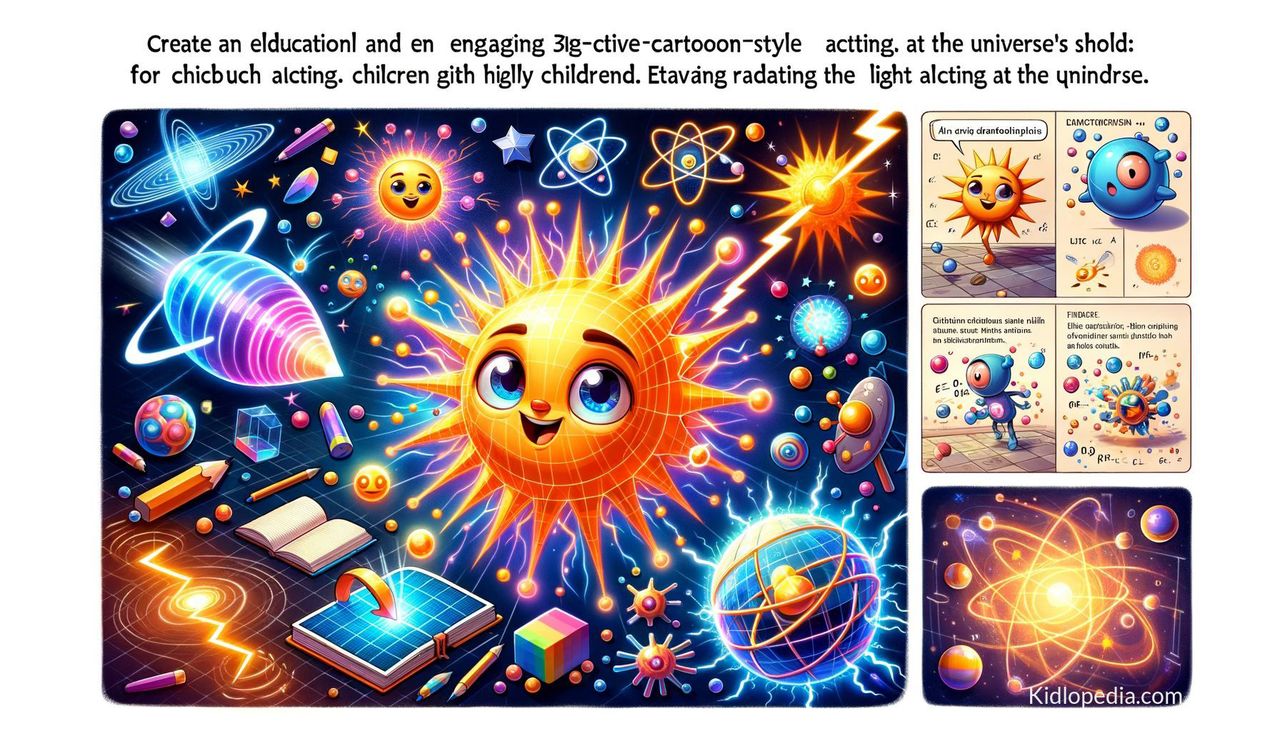
Light is a form of energy that travels in waves and can also behave like tiny particles called photons. In the quantum world, light interacts with electrons in unique ways, causing them to move between energy levels—this is important for understanding how we see colors and images. Quantum electrodynamics studies these interactions, helping us learn about the fundamental nature of light and its role in the universe.
Light is a form of energy that travels in waves and can also act like tiny particles called photons.
It plays an important role in how we see the world around us.
Light helps us observe colors and images, making it essential for our understanding of the universe.
In the quantum world, light interacts with electrons, which are tiny particles found in atoms.
When photons hit electrons, they can transfer energy.
This energy exchange allows electrons to jump between different energy levels.
When an electron absorbs a photon, it gains energy and moves up to a higher level.
Conversely, when it emits a photon, the electron loses energy and moves back down.
Quantum electrodynamics is the study of these interactions between light and electrons.
This field of science helps us understand how light behaves at a very small scale.
For example, sometimes light behaves like a wave, which is how it travels through space.
Other times, it acts like a particle, which helps explain how it interacts with matter.
Light is also responsible for the colors we see.
Different wavelengths of light correspond to different colors.
For instance, red light has a longer wavelength than blue light.
This is why we see a rainbow of colors when light passes through a prism.
Did you know that without light, we wouldn’t be able to see anything?
Also, lasers are made up of many photons working together to create a powerful beam of light!
For more exciting topics like this, visit Kidlopedia.com!
It plays an important role in how we see the world around us.
Light helps us observe colors and images, making it essential for our understanding of the universe.
In the quantum world, light interacts with electrons, which are tiny particles found in atoms.
When photons hit electrons, they can transfer energy.
This energy exchange allows electrons to jump between different energy levels.
When an electron absorbs a photon, it gains energy and moves up to a higher level.
Conversely, when it emits a photon, the electron loses energy and moves back down.
Quantum electrodynamics is the study of these interactions between light and electrons.
This field of science helps us understand how light behaves at a very small scale.
For example, sometimes light behaves like a wave, which is how it travels through space.
Other times, it acts like a particle, which helps explain how it interacts with matter.
Light is also responsible for the colors we see.
Different wavelengths of light correspond to different colors.
For instance, red light has a longer wavelength than blue light.
This is why we see a rainbow of colors when light passes through a prism.
Did you know that without light, we wouldn’t be able to see anything?
Also, lasers are made up of many photons working together to create a powerful beam of light!
For more exciting topics like this, visit Kidlopedia.com!