The Universe's Particles: The De Broglie-Bohm Theory
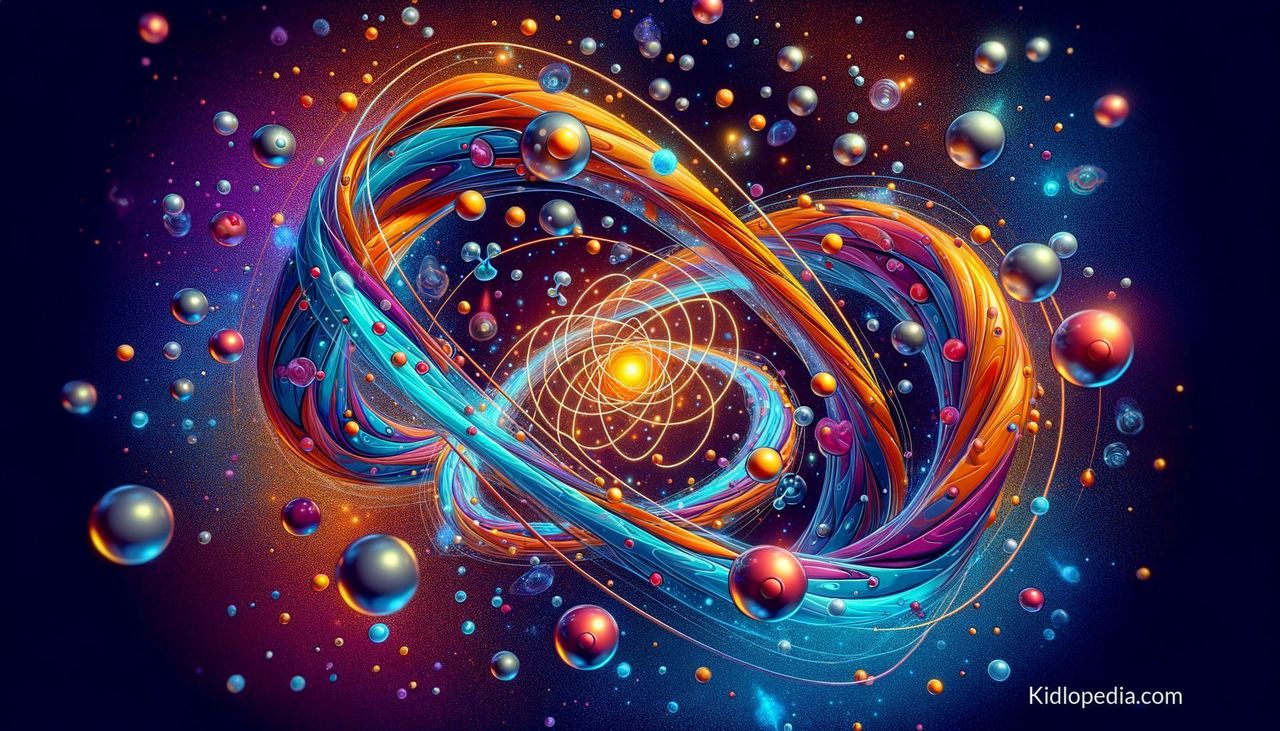
Particles are tiny bits of matter that make up everything in the universe, such as atoms and molecules. The De Broglie-Bohm theory suggests that each particle is accompanied by a guiding wave, known as a Pilot Wave, which influences its movement and behavior. This theory helps scientists understand how particles interact and navigate in the vast universe, showing us that there’s more to their actions than meets the eye.
Particles are tiny bits of matter that make up everything in the universe.
They are the building blocks of all things, such as atoms and molecules.
Each particle behaves in a specific way, which is important to understand how the universe works.
The De Broglie-Bohm theory is a scientific idea that suggests each particle is not alone.
Instead, it has a guiding wave called a Pilot Wave.
This wave helps determine how the particle moves and interacts with other particles.
Imagine a fish swimming in a river.
The water's current influences where the fish can go.
Similarly, the Pilot Wave influences the particle's behavior in the universe.
According to this theory, particles do not move randomly.
Their movement is influenced by their Pilot Wave, which acts like a map or guide.
This means that particles navigate through space in a way that we can predict.
Scientists use this theory to better understand complex interactions between particles.
Every particle in the universe, like tiny building blocks, is part of a much larger system.
The De Broglie-Bohm theory helps show us that there is more to their actions than it seems at first glance.
These guiding waves create a fascinating dance of interaction and movement in the cosmos.
Did you know that the concept of Pilot Waves can help scientists in fields like quantum mechanics?
It offers a new perspective on how everything in the universe is connected! Also, Louis de Broglie, who proposed this idea, was awarded the Nobel Prize in Physics for his contributions to quantum theory.
Explore more amazing topics at Kidlopedia.com!
They are the building blocks of all things, such as atoms and molecules.
Each particle behaves in a specific way, which is important to understand how the universe works.
The De Broglie-Bohm theory is a scientific idea that suggests each particle is not alone.
Instead, it has a guiding wave called a Pilot Wave.
This wave helps determine how the particle moves and interacts with other particles.
Imagine a fish swimming in a river.
The water's current influences where the fish can go.
Similarly, the Pilot Wave influences the particle's behavior in the universe.
According to this theory, particles do not move randomly.
Their movement is influenced by their Pilot Wave, which acts like a map or guide.
This means that particles navigate through space in a way that we can predict.
Scientists use this theory to better understand complex interactions between particles.
Every particle in the universe, like tiny building blocks, is part of a much larger system.
The De Broglie-Bohm theory helps show us that there is more to their actions than it seems at first glance.
These guiding waves create a fascinating dance of interaction and movement in the cosmos.
Did you know that the concept of Pilot Waves can help scientists in fields like quantum mechanics?
It offers a new perspective on how everything in the universe is connected! Also, Louis de Broglie, who proposed this idea, was awarded the Nobel Prize in Physics for his contributions to quantum theory.
Explore more amazing topics at Kidlopedia.com!