Aging Stars: Red Giants
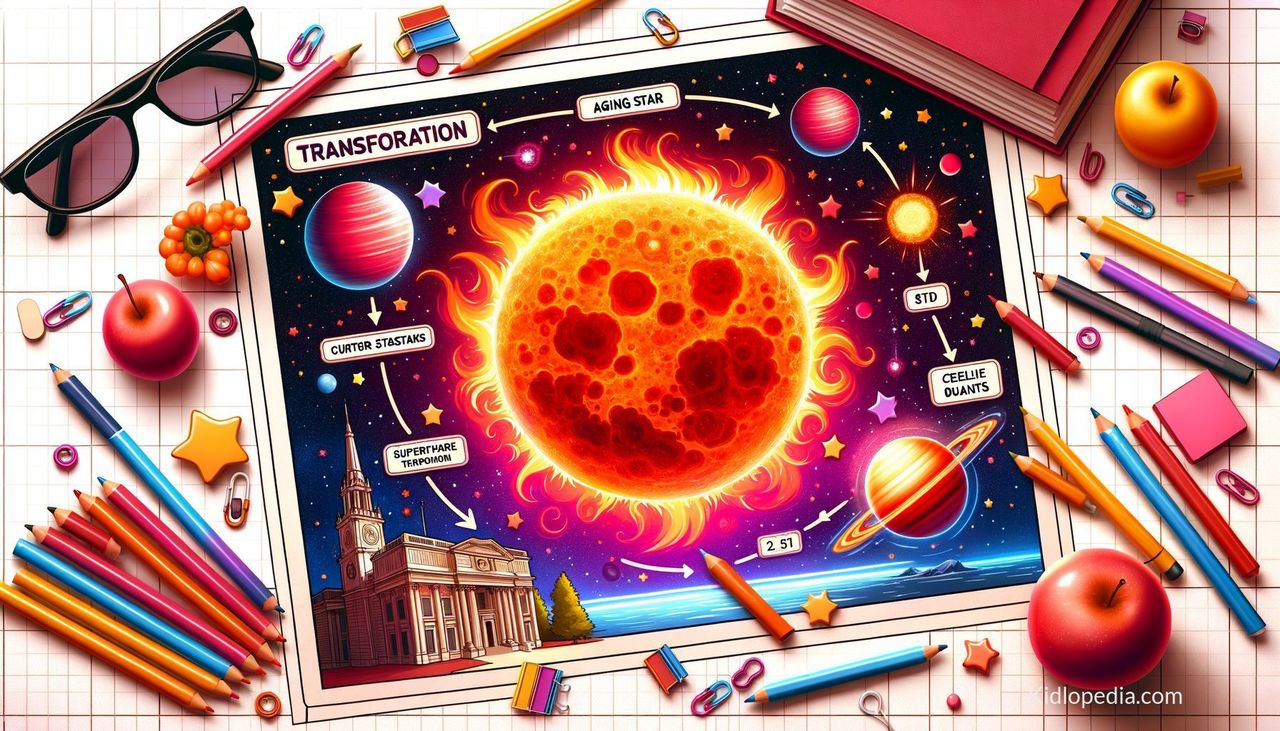
Red giants are large stars that have reached an advanced stage in their life cycle after exhausting the hydrogen fuel in their cores. During this phase, they expand significantly and change color, usually appearing red rather than blue or white. Understanding red giants is important because they play a key role in the evolution of galaxies and can influence the formation of new stars and planets.
Red giants are large stars that have reached a later stage in their life cycle.
They form when a star has exhausted the hydrogen fuel in its core.
Without hydrogen, the star begins to fuse helium and other elements, causing it to expand.
As they expand, red giants become much larger than they were earlier in their life.
During this phase, red giants also change color.
While many younger stars are white or blue, red giants appear red due to cooler surface temperatures.
This change happens gradually as the star ages.
Red giants are some of the largest stars in the universe and can be hundreds of times bigger than our Sun.
Red giants play important roles in the universe.
When they run out of fuel, they can undergo dramatic events.
Some may shed their outer layers and leave behind a core, leading to a formation called a white dwarf.
Others may explode in spectacular supernovae.
These explosions can create heavy elements that contribute to the formation of new stars and planets.
Did you know that the largest known red giant, UY Scuti, is over 1,700 times larger than the Sun?
Additionally, many red giants can be seen with the naked eye from Earth, twinkling brightly in the night sky.
To learn more fun facts about space and stars, visit Kidlopedia.com!
They form when a star has exhausted the hydrogen fuel in its core.
Without hydrogen, the star begins to fuse helium and other elements, causing it to expand.
As they expand, red giants become much larger than they were earlier in their life.
During this phase, red giants also change color.
While many younger stars are white or blue, red giants appear red due to cooler surface temperatures.
This change happens gradually as the star ages.
Red giants are some of the largest stars in the universe and can be hundreds of times bigger than our Sun.
Red giants play important roles in the universe.
When they run out of fuel, they can undergo dramatic events.
Some may shed their outer layers and leave behind a core, leading to a formation called a white dwarf.
Others may explode in spectacular supernovae.
These explosions can create heavy elements that contribute to the formation of new stars and planets.
Did you know that the largest known red giant, UY Scuti, is over 1,700 times larger than the Sun?
Additionally, many red giants can be seen with the naked eye from Earth, twinkling brightly in the night sky.
To learn more fun facts about space and stars, visit Kidlopedia.com!