Observing Universe: Space Telescopes
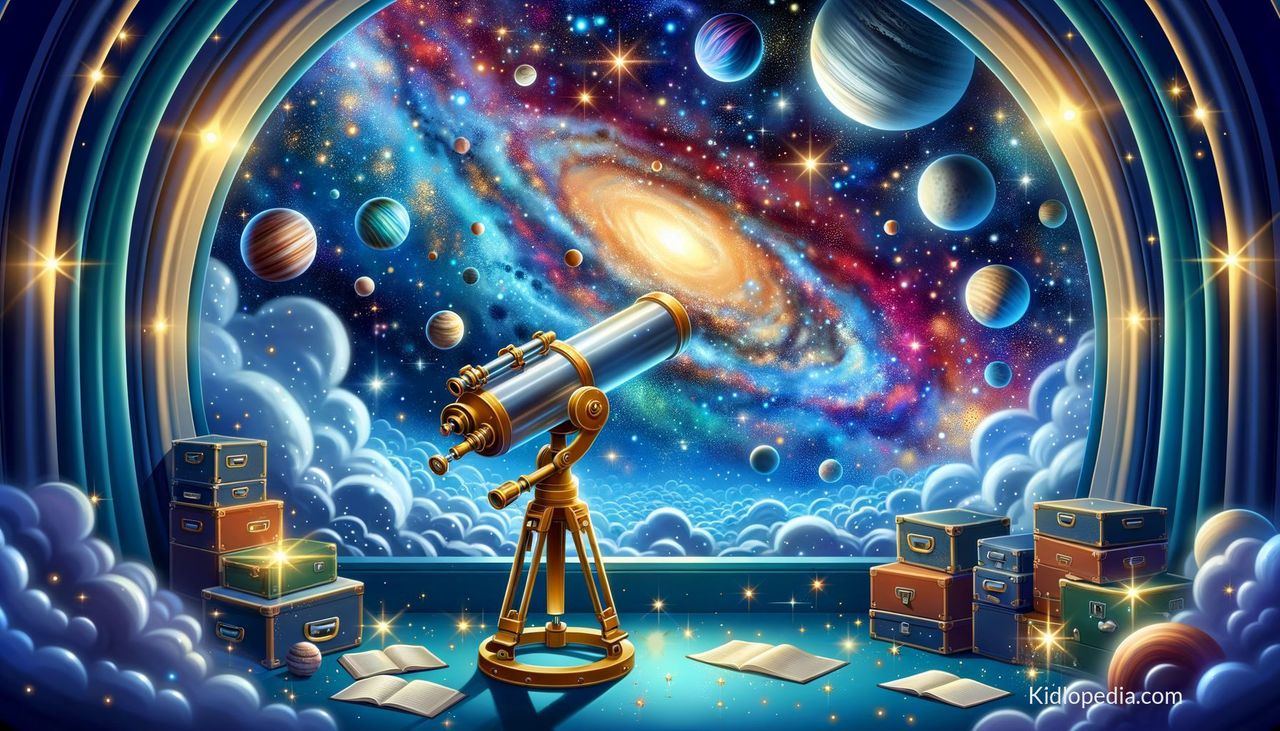
Space telescopes are powerful tools that allow scientists to observe distant stars, planets, and galaxies in the universe. They work by using large mirrors to collect light from these faraway objects and send images back to Earth for study. This technology helps us learn more about the cosmos, including the formation of stars and the existence of black holes.
Space telescopes are special tools that scientists use to look at the universe from outside Earth's atmosphere.
They help us study faraway stars, planets, and galaxies.
Unlike regular telescopes, space telescopes are positioned high above Earth, which allows them to see clearly without the distortion caused by the atmosphere.
Space telescopes work mainly by using large mirrors.
These mirrors collect light from distant objects in space.
When the light hits the mirror, it is reflected and focused.
The telescope then converts this light into images and data.
These images are sent back to Earth for scientists to analyze.
This process allows us to see objects that are billions of light-years away.
One of the most famous space telescopes is the Hubble Space Telescope.
Launched in 1990, it has provided stunning images of galaxies, nebulae, and even other planets in our solar system.
Hubble helps scientists learn about how stars are born, how they live, and how they die.
It has also helped discover the presence of black holes.
Space telescopes are essential for exploring the universe.
They provide important information about the formation of planets and the structure of the universe itself.
By studying the images and data collected, scientists can answer many questions about space and its mysteries.
Did you know that space telescopes can also detect infrared light?
This allows them to see through dust clouds that block visible light.
Also, the James Webb Space Telescope, launched in December 2021, is expected to help us see even deeper into the universe than ever before!
If you’re curious about more exciting topics, visit Kidlopedia.com to learn more!
They help us study faraway stars, planets, and galaxies.
Unlike regular telescopes, space telescopes are positioned high above Earth, which allows them to see clearly without the distortion caused by the atmosphere.
Space telescopes work mainly by using large mirrors.
These mirrors collect light from distant objects in space.
When the light hits the mirror, it is reflected and focused.
The telescope then converts this light into images and data.
These images are sent back to Earth for scientists to analyze.
This process allows us to see objects that are billions of light-years away.
One of the most famous space telescopes is the Hubble Space Telescope.
Launched in 1990, it has provided stunning images of galaxies, nebulae, and even other planets in our solar system.
Hubble helps scientists learn about how stars are born, how they live, and how they die.
It has also helped discover the presence of black holes.
Space telescopes are essential for exploring the universe.
They provide important information about the formation of planets and the structure of the universe itself.
By studying the images and data collected, scientists can answer many questions about space and its mysteries.
Did you know that space telescopes can also detect infrared light?
This allows them to see through dust clouds that block visible light.
Also, the James Webb Space Telescope, launched in December 2021, is expected to help us see even deeper into the universe than ever before!
If you’re curious about more exciting topics, visit Kidlopedia.com to learn more!