The Amazing World Book
Everything Kids Need to Know
Science, Cultures, and Goodness
What is Rain?How Rain FormsWhat is a Rainbow?How Rainbows FormWhat is Honey?How Bees Make HoneyWhat are Flowers?How Flowers GrowWhat are Snakes?Be Careful Around SnakesWhat is Electricity?How Electricity WorksBe Careful Around ElectricityWhat is Fire?What is the Internet?How the Internet WorksWhy is it Dark at Night?What is Snow?How Snow FormsWhat is Shopping?What is Money?What is Saving?How to Save MoneyWhat is Global Warming?How Airplanes FlyWhat is Gravity?Why There is No Gravity on the Moon?What is Economy?How the TV WorksWhat is War?What to Do if InjuredWhat to Do if SickWhat to Do if Someone CollapsesWhat to Do in an AccidentWhat to Do if a Stranger Approaches YouStaying Safe: Health and SafetyContributing to Society: Being a Good CitizenValues and Behavior: Being a Good KidLoyalty and Support: Being a Good FriendBuilding Strong Friendships: FriendsStanding Up for Others: Mitigating BullyingRespect and Love: Parents and Family CareTaking Care of Yourself: Self-CareBasic Skills and Nutrition: CookingCommunication and Diversity: LanguagesEffective Communication: Public SpeakingBuilding Connections: NetworkingPromoting Health: Health EducationPhysical Activity and Teamwork: SportsBasic Skills and Nutrition: CookingHealthy Eating: NutritionFood and Health: DieteticsEmergency Care: First AidLifesaving Techniques: CPRBeing Ready: Disaster PreparednessStaying Safe Online: CyberbullyingResponsible Use: Digital CitizenshipOnline Manners: NetiquetteProtecting Privacy: Social Media SafetyFinding Information: Online ResearchWriting Programs: CodingCreating Websites: Web DesignMaking Applications: App DevelopmentCreating Games: Game DesignMaking Objects: 3D PrintingImmersive Experiences: Virtual RealityEnhancing Reality: Augmented RealityTeaching Computers: Machine LearningAnalyzing Information: Big DataSecure Transactions: BlockchainDigital Money: CryptocurrencyFinancial Technology: FintechOnline Shopping: E-commerceBusiness for Good: Social EntrepreneurshipHelping Others: Nonprofit OrganizationsGiving Time: VolunteeringSupporting Causes: FundraisingHelping in Need: Charity WorkLocal Involvement: Community ServiceGuiding Others: MentorshipLeading Effectively: Leadership SkillsCreating Teams: Team BuildingSolving Disputes: Conflict ResolutionReaching Agreements: NegotiationManaging Image: Public RelationsPromoting Ideas: MarketingReaching Audiences: AdvertisingSelling Products: SalesHelping Clients: Customer ServiceManaging People: Human ResourcesOrganizing Tasks: Project ManagementUsing Time Wisely: Time ManagementPlanning Achievements: Goal SettingGetting Things Done: ProductivityHandling Pressure: Stress ManagementManaging Time: Work-Life BalanceBuilding a Future: Career PlanningGetting Hired: Job Interview SkillsShowcasing Skills: Resume WritingBuilding Connections: NetworkingBuilding Reputation: Personal BrandingContinuous Learning: Professional DevelopmentManaging Money: Financial LiteracyPlanning Finances: BudgetingBuilding Wealth: SavingGrowing Money: InvestingFuture Security: Retirement PlanningProtecting Assets: InsuranceManaging Taxes: Tax PlanningBuying and Selling Property: Real EstateTaking Care of Property: Home MaintenanceCreating Spaces: Interior DesignMaking Things Yourself: DIY ProjectsEco-Friendly Choices: Sustainable LivingSimple Living: MinimalismOrganizing Spaces: DeclutteringReducing Waste: RecyclingEnriching Soil: CompostingClean Power: Green EnergySaving Water: Water ConservationProtecting Species: Wildlife PreservationUnderstanding Impact: Climate ChangeEco-Friendly Farming: Sustainable AgricultureGrowing in Cities: Urban FarmingSustainable Systems: PermacultureNatural Growing: Organic GardeningSoilless Farming: HydroponicsFish and Plant Farming: AquaponicsRaising Bees: BeekeepingManaging Forests: ForestrySustainable Fishing: FisheriesProtecting Oceans: Marine ConservationObserving Birds: BirdwatchingCapturing Wildlife: Nature PhotographyExploring Trails: HikingEnjoying Outdoors: CampingTraveling Light: BackpackingScaling Heights: Rock ClimbingPaddling Adventures: KayakingWater Travels: CanoeingNavigating Waters: SailingUnderwater Exploration: Scuba DivingSurface Diving: SnorkelingRiding Waves: SurfingSailing on Waves: WindsurfingWind and Water Sport: KiteboardingOff-Road Cycling: Mountain BikingLong-Distance Riding: Road CyclingStaying Fit: RunningLong-Distance Running: Marathon TrainingMulti-Sport Race: TriathlonBuilding Strength: WeightliftingMuscle Building: BodybuildingHigh-Intensity Training: CrossFitBody Control: GymnasticsFlexibility and Balance: YogaCore Strength: PilatesMovement and Grace: DanceSelf-Defense: Martial ArtsCombat Sport: BoxingFitness Sport: KickboxingGrappling Sport: WrestlingGentle Way Martial Art: JudoEmpty Hand Martial Art: KarateKicking Techniques: TaekwondoHarmonious Spirit: AikidoSelf-Defense System: Krav MagaGentle Art: JujitsuCombining Techniques: Mixed Martial ArtsSword Fighting: FencingBow and Arrow: ArcheryTarget Practice: ShootingWildlife Tracking: HuntingCatching Fish: FishingWildlife Capture: TrappingWilderness Living: Survival SkillsNature Skills: BushcraftNavigation Sport: OrienteeringTreasure Hunting: GeocachingObserving Stars: StargazingCapturing Space: AstrophotographyShooting Stars: Meteor WatchingStudying Planets: Planetary ScienceFinding Other Worlds: Exoplanet ExplorationThe Universe's Origin: CosmologyExploring Space: Space MissionsLiving in Space: Space StationsOrbiting Tools: Satellite TechnologyBuilding Rockets: Rocket ScienceObserving Universe: Space TelescopesSpace Research: Astronomical ObservatoriesBeyond Our Galaxy: Interstellar TravelLiving on Other Planets: Space ColonizationTraveling to Space: Space TourismSearching for Aliens: Extraterrestrial LifeSearch for Extraterrestrial Intelligence: SETIPreparing for Space: Astronaut TrainingBuilding Space Vehicles: Spacecraft EngineeringWalking in Space: SpacewalksThe Force of Attraction: GravityThe Cosmic Giants: Black HolesThe Invisible Mass: Dark MatterThe Mysterious Force: Dark EnergyThe Universe's Birth: The Big BangCosmic Cities: GalaxiesCelestial Objects: StarsExploding Stars: SupernovaeStar-Forming Regions: NebulaeBrightest Objects: QuasarsSpinning Stars: PulsarsSmall Stars: White DwarfsAging Stars: Red GiantsDense Stars: Neutron StarsFailed Stars: Brown DwarfsChanging Brightness: Variable StarsStellar Pairs: Binary StarsStellar Groups: Star ClustersCosmic Clusters: Galaxy ClustersOur Galaxy: The Milky WayOur Neighbor Galaxy: AndromedaOur Cosmic Neighborhood: The Local GroupGalaxy Group: The Virgo ClusterGalaxy Cluster: The Coma ClusterCosmic Mystery: The Great AttractorUniverse's Structure: The Cosmic WebThe Visible Part: The Observable UniverseMultiple Universes: The MultiverseThe Universe's Echo: The Cosmic Microwave BackgroundUniverse's Expansion Rate: The Hubble ConstantThe Universe's Stretch: The RedshiftThe Universe's Compression: The BlueshiftThe Sound Shift: The Doppler EffectWhere Are the Aliens?: The Fermi ParadoxEstimating Extraterrestrial Life: The Drake EquationHabitable Regions: The Goldilocks ZoneUniqueness of Earth: The Rare Earth HypothesisObserving the Universe: The Anthropic PrincipleThe Universe's Precision: The Fine-Tuning ArgumentThe Universe's Reality: The Simulation HypothesisThe Cosmic Challenge: The Great FilterMeasuring Civilizations: The Kardashev ScalePlanetary Control: Type I CivilizationStellar Control: Type II CivilizationGalactic Control: Type III CivilizationUniversal Control: Type IV CivilizationMultiversal Control: Type V CivilizationSelf-Replicating Machines: The Von Neumann ProbeStellar Energy: The Dyson SphereCosmic Computation: The Matrioshka BrainUltimate Destiny: The Omega PointThe Universe's End: The Heat DeathThe Universe's Tear: The Big RipThe Universe's Collapse: The Big CrunchThe Universe's Rebirth: The Big BounceThe Universe's Cycle: The Cyclic ModelThe Universe's Stability: The Steady State TheoryThe Subatomic World: The Quantum UniverseThe Universe's Strings: String TheoryThe Ultimate Theory: M-TheoryThe Universe's Loops: Loop Quantum GravityThe Universe's Projection: The Holographic PrincipleThe Universe's Diversity: The Anthropic MultiverseThe Universe's Neighbors: The Parallel UniversesThe Universe's Branches: The Many-Worlds InterpretationThe Universe's Splits: The Everett InterpretationThe Universe's Collapse: The Copenhagen InterpretationThe Universe's Guidance: The Pilot Wave TheoryThe Universe's Particles: The De Broglie-Bohm TheoryThe Universe's Fields: The Quantum Field TheoryThe Universe's Particles: The Standard ModelThe Universe's Mass: The Higgs BosonThe Universe's Balance: SupersymmetryThe Universe's Forces: The Grand Unified TheoryThe Universe's Explanation: The Theory of EverythingThe Universe's Vibrations: Superstring TheoryThe Universe's Membranes: The Brane TheoryThe Universe's Dimensions: The Multidimensional UniverseThe Universe's Texture: The Quantum FoamThe Universe's Smallest Units: The Planck ScaleThe Universe's Gravity: Quantum GravityThe Universe's Quarks: Quantum ChromodynamicsThe Universe's Light: Quantum ElectrodynamicsThe Universe's Rules: Quantum MechanicsThe Universe's Connections: Quantum EntanglementThe Universe's States: Quantum SuperpositionThe Universe's Leaps: Quantum TunnelingThe Universe's Processing: Quantum ComputationBasics of Life: BiologyUnderstanding Our Planet: GeographyThe Wonders of Space: AstronomyThe Laws of Nature: PhysicsRules and Justice: Law and OrderExpressing Creativity: ArtsThe Building Blocks of Matter: ChemistryTools and Innovations: TechnologyThe Circle of Life: NatureExploring Careers: ProfessionsLearning from the Past: HistoryNumbers and Logic: MathematicsSounds and Rhythms: MusicProtecting Our Planet: Environmental ScienceMoney and Trade: EconomicsStories and Poems: LiteratureBuilding and Designing: EngineeringGrowing Plants: GardeningLife Underwater: Marine BiologyWeather and Climate: MeteorologyStudy of Animals: ZoologyStudy of Plants: BotanyHuman Societies: AnthropologyDiscovering the Past: ArchaeologyUnderstanding the Mind: PsychologyStudy of Communities: SociologyThinking Deeply: PhilosophyBuilding Design: ArchitectureMovement and Expression: DanceActing and Theater: DramaGovernment and Society: CivicsExploring Space: AstronauticsRight and Wrong: EthicsGuiding and Inspiring: LeadershipStarting Businesses: EntrepreneurshipCreating New Ideas: InnovationNavigating Technology: Digital LiteracyCapturing Moments: PhotographyMaking Movies: FilmVisual Communication: Graphic DesignFinding Solutions: Problem-SolvingAnalyzing Information: Critical ThinkingBeing Present: MindfulnessPhysical and Mental Balance: YogaStars and Galaxies: AstronomyLife Beyond Earth: AstrobiologyInheritance and Variation: GeneticsThe World of Microbes: MicrobiologyEcosystems and Habitats: EcologySustainable Power: Renewable EnergyDesigning Cities: Urban PlanningProtecting Animals: Wildlife ConservationTraditions and Customs: Cultural HeritagePromoting Harmony: Peace StudiesStudy of Oceans: OceanographyEarth's Structure: GeologyStudy of Volcanoes: VolcanologyStudy of Earthquakes: SeismologyStudy of Fossils: PaleontologyStudy of the Universe: AstrophysicsProtecting Information: CybersecuritySmart Machines: Artificial IntelligenceBuilding Robots: RoboticsSmall Innovations: NanotechnologyLife Science Applications: BiotechnologyCrime Scene Investigation: ForensicsThe Immune System: ImmunologyStudy of Viruses: VirologyStudy of Diseases: PathologyStudy of Medicines: PharmacologyAnimal Health: Veterinary ScienceBone Health: OrthopedicsHeart Health: CardiologyStudy of the Nervous System: NeurologyEye Health: OphthalmologySkin Health: DermatologyDigestive Health: GastroenterologyHormones and Glands: Endocrinology

The Circle of Life: Nature
The Circle of Life: Nature

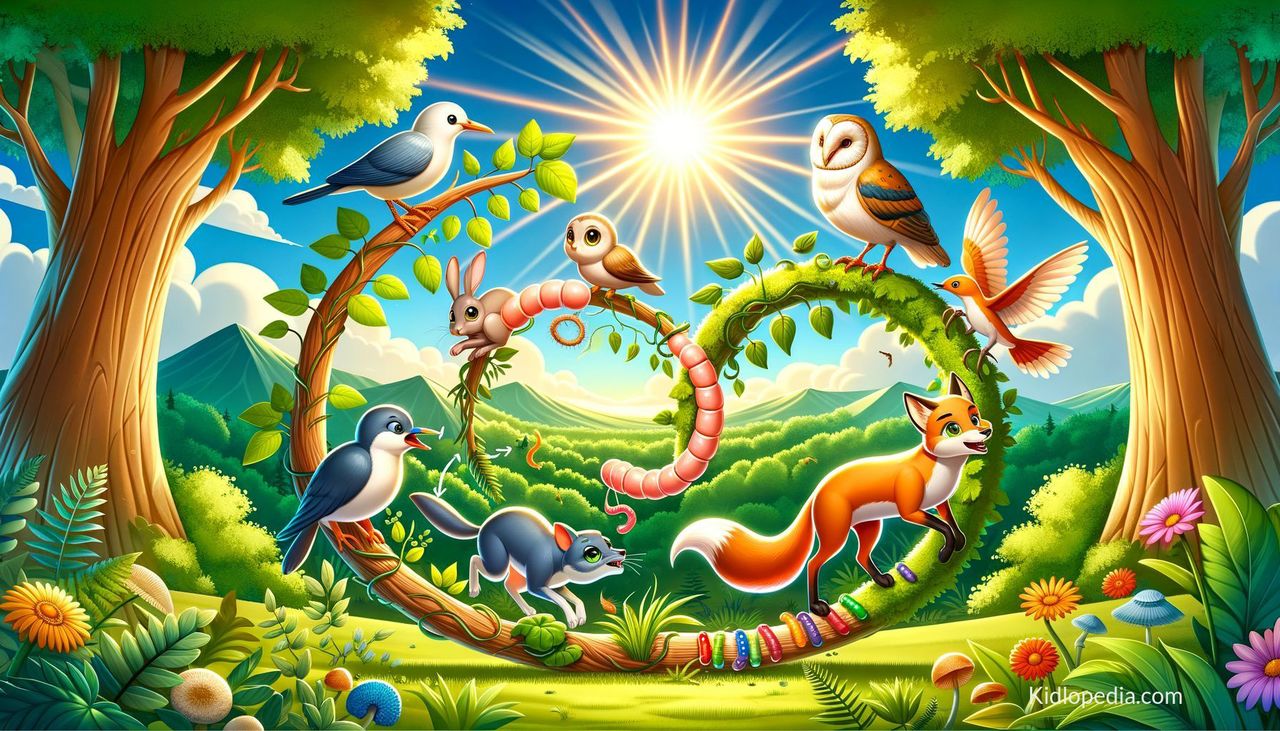
The Circle of Life is the natural cycle that shows how all living things depend on each other for survival. In this cycle, plants provide food and shelter for animals, while animals help plants grow and spread by pollinating flowers and dispersing seeds. Understanding the Circle of Life is important because it teaches us about the connections in nature and how each creature and plant has a role in keeping the environment healthy.

The Circle of Life is a natural cycle that shows how all living things depend on each other for survival.

It includes plants, animals, and even tiny organisms.

Each part of this cycle plays a role in keeping the environment healthy.

For example, plants provide food and shelter for animals, while animals help plants grow and spread.

Plants produce their own food using sunlight, air, and water.

They are important because they release oxygen into the air, which animals need to breathe.

Animals, like squirrels and bees, use plants for food and homes.

In return, they help plants in various ways.

For instance, when bees collect nectar, they also move pollen from flower to flower, helping plants grow seeds.

Many animals eat fruits, nuts, and seeds from plants.

When they do, they sometimes carry seeds to new locations.

This helps plants grow in different areas, spreading their species.

Decomposers, like mushrooms and bacteria, break down dead plants and animals.

This process turns them into nutrients that feed the soil, helping new plants to thrive.

The Circle of Life teaches us how everything is connected.

Each creature and plant has a role to play, creating a balance in nature.

If one part of the cycle is affected, it can impact everyone else.

Did you know?

A single tree can produce thousands of seeds in its lifetime, helping to grow many more plants! Also, some plants rely only on specific animals, like certain bees, for pollination.

Explore more fascinating topics at Kidlopedia.com!