The Universe's Stretch: The Redshift
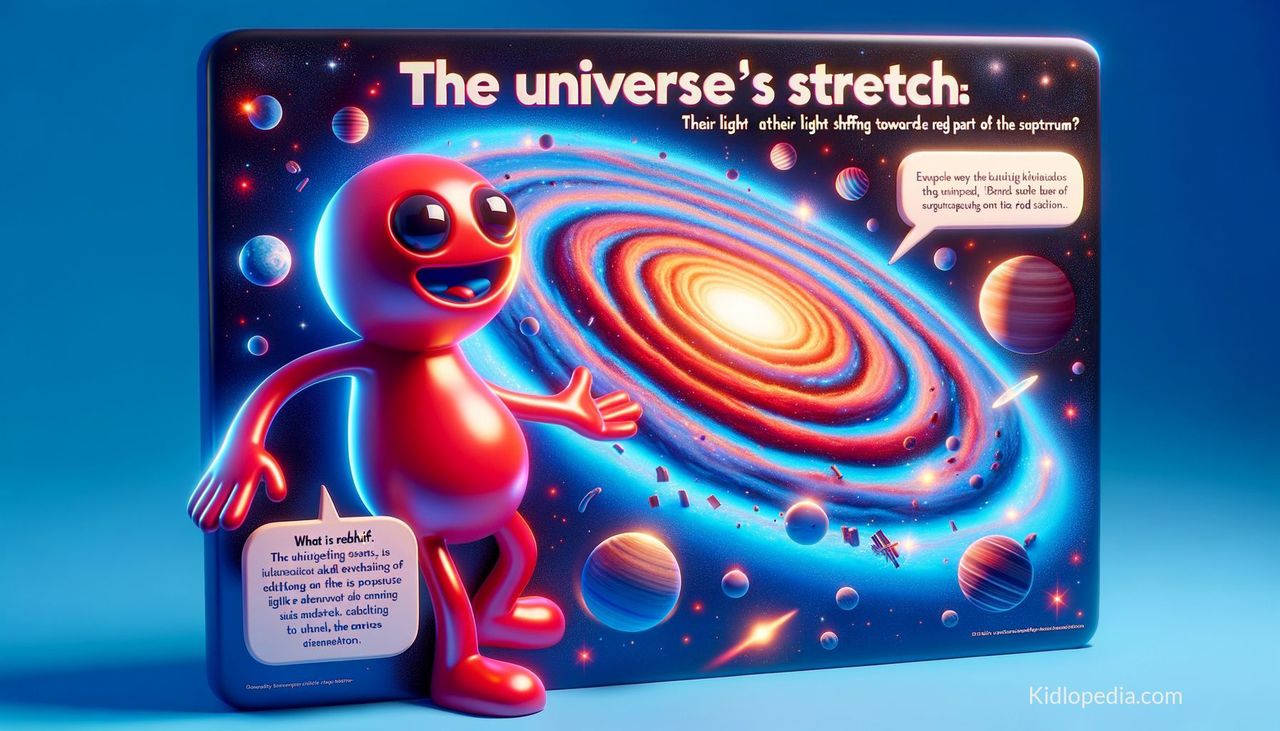
Redshift is a phenomenon that occurs when light from distant stars and galaxies shifts to longer wavelengths, making it appear more red. This happens because the universe is expanding, which stretches the light waves as they travel to us. Understanding redshift helps scientists determine how far away these objects are and how quickly they are moving away from us, providing important information about the universe.
Redshift is a phenomenon that occurs when light from distant stars and galaxies shifts toward longer wavelengths, making the light appear more red.
This happens because the universe is expanding.
As the universe stretches, the light waves from faraway objects are stretched out too.
When light travels through space, it can be affected by the movement of the objects emitting the light.
If an object, like a galaxy, is moving away from us, the light it emits gets stretched.
This stretching of light is similar to how a rubber band stretches when pulled.
The longer the light travels, the more it gets stretched, leading to a color change.
Scientists can measure this change in light to learn about the universe.
By examining how much the light has shifted to red, they can calculate how far away these stars and galaxies are.
This helps us understand how fast the universe is expanding.
The faster a galaxy moves away, the more its light shifts to red, indicating it is further away.
Redshift is also important for studying the history of our universe.
By analyzing the redshift of various galaxies, scientists can piece together how they formed and evolved over time.
This information is crucial for understanding concepts like the Big Bang and the overall structure of the cosmos.
Did you know?
The greater the redshift, the faster a galaxy is moving away from us.
The most distant galaxies have the highest redshift, showing that the universe has been expanding for a very long time.
Explore more exciting topics at Kidlopedia.com!
This happens because the universe is expanding.
As the universe stretches, the light waves from faraway objects are stretched out too.
When light travels through space, it can be affected by the movement of the objects emitting the light.
If an object, like a galaxy, is moving away from us, the light it emits gets stretched.
This stretching of light is similar to how a rubber band stretches when pulled.
The longer the light travels, the more it gets stretched, leading to a color change.
Scientists can measure this change in light to learn about the universe.
By examining how much the light has shifted to red, they can calculate how far away these stars and galaxies are.
This helps us understand how fast the universe is expanding.
The faster a galaxy moves away, the more its light shifts to red, indicating it is further away.
Redshift is also important for studying the history of our universe.
By analyzing the redshift of various galaxies, scientists can piece together how they formed and evolved over time.
This information is crucial for understanding concepts like the Big Bang and the overall structure of the cosmos.
Did you know?
The greater the redshift, the faster a galaxy is moving away from us.
The most distant galaxies have the highest redshift, showing that the universe has been expanding for a very long time.
Explore more exciting topics at Kidlopedia.com!