The Invisible Mass: Dark Matter
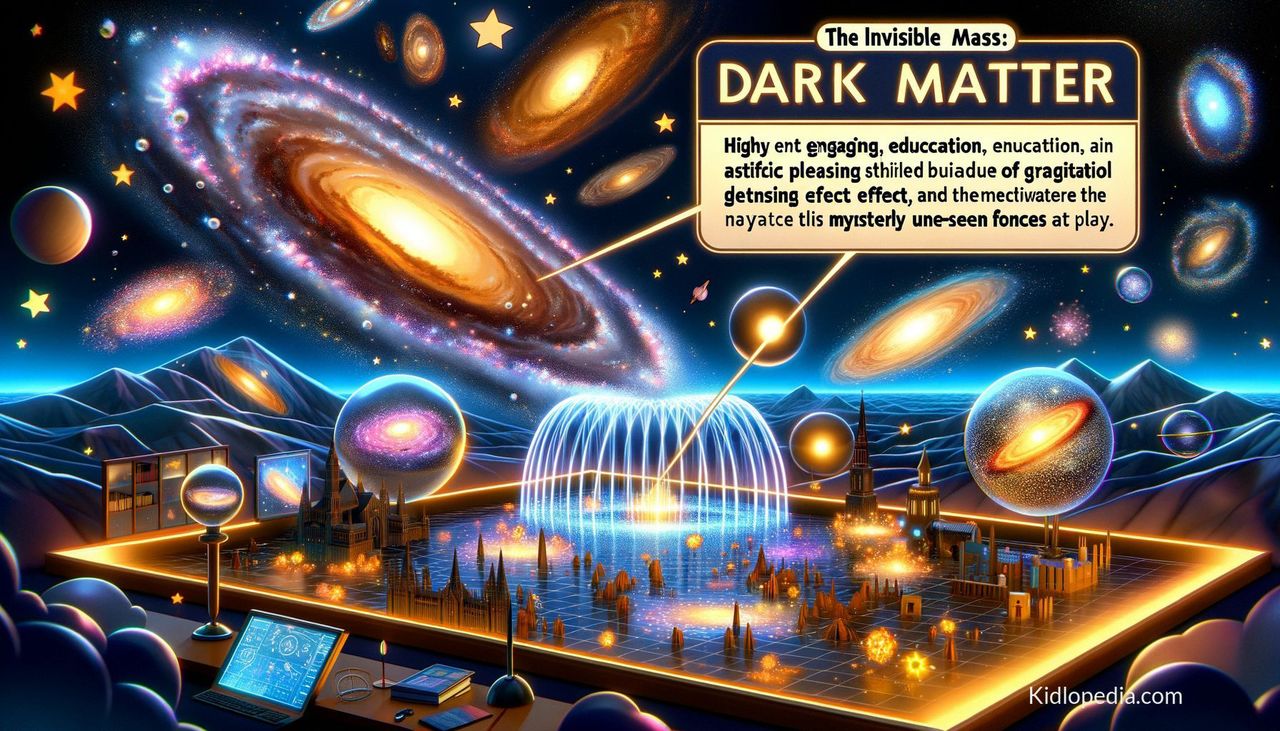

Dark matter is a type of matter that cannot be seen directly because it does not emit light. It is believed to make up about 27% of the universe's total mass and plays a crucial role in holding galaxies together by providing the gravitational force needed to keep stars and planets in motion. Understanding dark matter helps scientists learn more about how the universe works and why it is structured the way it is.
Dark matter is a type of matter that cannot be seen directly because it does not emit or reflect light.
Scientists believe it makes up about 27% of the universe’s total mass.
Even though we cannot see dark matter, it has a significant impact on how the universe behaves.
Dark matter plays a crucial role in the structure of galaxies.
It surrounds galaxies and provides the gravitational force needed to keep stars and planets in motion.
Without dark matter, galaxies would not hold together properly.
They would not be able to form, and stars and planets would drift apart.
Scientists study dark matter by observing how it affects the motion of stars and galaxies.
For example, when they look at galaxies, they notice that the stars on the outer edges spin much faster than expected.
This suggests there is extra mass, which they cannot see—this is dark matter.
Through these observations, scientists can infer where dark matter exists in the universe.
Understanding dark matter helps scientists learn more about the universe’s overall structure and evolution.
It explains why galaxies are formed the way they are and how they continue to exist together in space.
Although it cannot be observed directly, dark matter is essential for our understanding of how everything in the universe is connected.
Did you know that dark matter does not interact with light, which makes it invisible?
Researchers are still trying to uncover its mysteries to learn more about the universe!
For more exciting topics like this, visit Kidlopedia.com!
Scientists believe it makes up about 27% of the universe’s total mass.
Even though we cannot see dark matter, it has a significant impact on how the universe behaves.
Dark matter plays a crucial role in the structure of galaxies.
It surrounds galaxies and provides the gravitational force needed to keep stars and planets in motion.
Without dark matter, galaxies would not hold together properly.
They would not be able to form, and stars and planets would drift apart.
Scientists study dark matter by observing how it affects the motion of stars and galaxies.
For example, when they look at galaxies, they notice that the stars on the outer edges spin much faster than expected.
This suggests there is extra mass, which they cannot see—this is dark matter.
Through these observations, scientists can infer where dark matter exists in the universe.
Understanding dark matter helps scientists learn more about the universe’s overall structure and evolution.
It explains why galaxies are formed the way they are and how they continue to exist together in space.
Although it cannot be observed directly, dark matter is essential for our understanding of how everything in the universe is connected.
Did you know that dark matter does not interact with light, which makes it invisible?
Researchers are still trying to uncover its mysteries to learn more about the universe!
For more exciting topics like this, visit Kidlopedia.com!