The Universe's Strings: String Theory
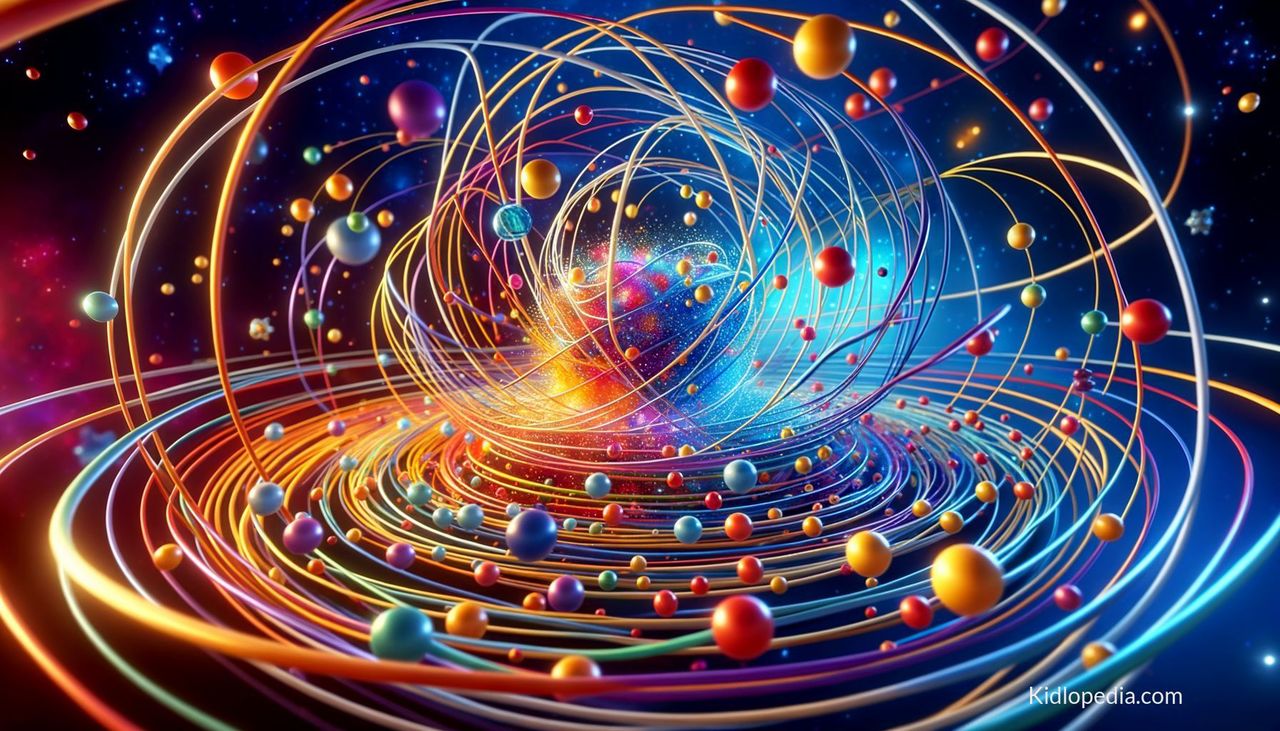
String theory is a scientific idea that suggests everything in the universe is made up of tiny, vibrating strings. These strings are much smaller than atoms and can stretch and move in different ways, creating the various particles and forces that make up all matter and energy. Understanding string theory helps scientists explore the fundamental nature of reality and how the universe works.
String theory is a scientific idea that suggests everything in the universe is made up of tiny, vibrating strings.
These strings are much smaller than atoms and cannot be seen by the naked eye.
They can stretch and move in different ways, which creates various particles and forces that form all matter and energy.
In string theory, particles like electrons, protons, and neutrons are not point-like dots, but rather tiny loops or strands.
When a string vibrates in one way, it represents one type of particle; when it vibrates differently, it represents another type.
This is similar to how different musical notes create different sounds.
The way a string vibrates determines what type of particle is formed.
String theory also explains forces in the universe.
For example, it helps scientists understand gravity and electromagnetism.
These forces arise from the way strings interact with each other.
By studying these interactions, scientists hope to unlock the mysteries of how the universe works at the most fundamental level.
Understanding string theory is essential for scientists who wish to explore the nature of reality.
It provides a framework for unifying the different forces in the universe.
Scientists are still working on proving string theory, as it requires advanced math and technology.
Did you know that if string theory is correct, it might mean there are more dimensions beyond the ones we can see?
Some scientists believe there could be as many as ten dimensions!
Explore more fascinating topics like this at Kidlopedia.com!
These strings are much smaller than atoms and cannot be seen by the naked eye.
They can stretch and move in different ways, which creates various particles and forces that form all matter and energy.
In string theory, particles like electrons, protons, and neutrons are not point-like dots, but rather tiny loops or strands.
When a string vibrates in one way, it represents one type of particle; when it vibrates differently, it represents another type.
This is similar to how different musical notes create different sounds.
The way a string vibrates determines what type of particle is formed.
String theory also explains forces in the universe.
For example, it helps scientists understand gravity and electromagnetism.
These forces arise from the way strings interact with each other.
By studying these interactions, scientists hope to unlock the mysteries of how the universe works at the most fundamental level.
Understanding string theory is essential for scientists who wish to explore the nature of reality.
It provides a framework for unifying the different forces in the universe.
Scientists are still working on proving string theory, as it requires advanced math and technology.
Did you know that if string theory is correct, it might mean there are more dimensions beyond the ones we can see?
Some scientists believe there could be as many as ten dimensions!
Explore more fascinating topics like this at Kidlopedia.com!