The Universe's Rules: Quantum Mechanics
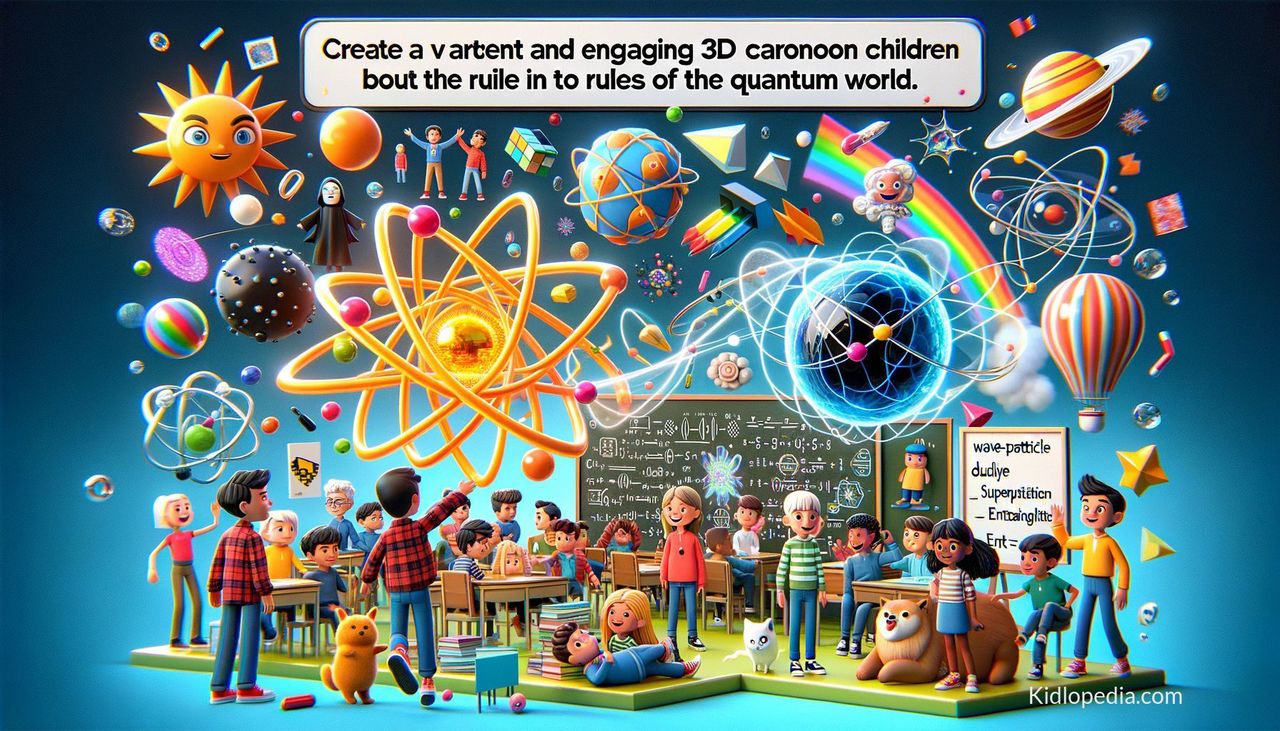
Quantum mechanics is the branch of physics that studies the behavior of very small particles, like atoms and photons. It reveals fascinating rules, such as superposition, where particles can exist in multiple states at once, and entanglement, where particles can be connected over distances. Understanding these rules helps scientists explain how the universe operates at its most fundamental level, leading to advancements in technology and our knowledge of the natural world.
Quantum mechanics is the branch of physics that studies very small particles, such as atoms and photons.
It describes how these tiny particles behave and interact with one another.
Quantum mechanics introduces several important rules that help scientists understand the fundamental aspects of the universe.
One key rule is called superposition.
Superposition means that particles can exist in multiple states at the same time.
For example, a particle might be in one place and another place simultaneously.
It is only when we measure or observe the particle that it "chooses" a specific location or state.
This is different from our everyday experiences, where objects can only be in one place at a time.
Another important concept in quantum mechanics is entanglement.
Entangled particles are connected in such a way that the state of one particle instantly affects the state of another, no matter how far apart they are.
This means that if something happens to one entangled particle, the other particle will "know" about it right away.
This connection challenges our understanding of space and distance.
There is also the Uncertainty Principle.
This principle tells us that we cannot know both the exact position and the exact speed of a particle at the same time.
The more accurately we know one of these properties, the less accurately we can know the other.
This idea can seem strange, but it is a fundamental feature of how particles behave at the quantum level.
Finally, particles can change or "pop" in and out of existence.
This means they can appear and disappear suddenly, unlike larger objects that we see every day.
This behavior is part of what makes the quantum world unique and fascinating.
Did you know?
Quantum mechanics has led to many technological advances, such as computers and lasers, that we use in our everyday lives.
Also, researchers are studying quantum physics to develop new technologies like quantum computers, which could revolutionize how we process information.
Explore more amazing topics at Kidlopedia.com!
It describes how these tiny particles behave and interact with one another.
Quantum mechanics introduces several important rules that help scientists understand the fundamental aspects of the universe.
One key rule is called superposition.
Superposition means that particles can exist in multiple states at the same time.
For example, a particle might be in one place and another place simultaneously.
It is only when we measure or observe the particle that it "chooses" a specific location or state.
This is different from our everyday experiences, where objects can only be in one place at a time.
Another important concept in quantum mechanics is entanglement.
Entangled particles are connected in such a way that the state of one particle instantly affects the state of another, no matter how far apart they are.
This means that if something happens to one entangled particle, the other particle will "know" about it right away.
This connection challenges our understanding of space and distance.
There is also the Uncertainty Principle.
This principle tells us that we cannot know both the exact position and the exact speed of a particle at the same time.
The more accurately we know one of these properties, the less accurately we can know the other.
This idea can seem strange, but it is a fundamental feature of how particles behave at the quantum level.
Finally, particles can change or "pop" in and out of existence.
This means they can appear and disappear suddenly, unlike larger objects that we see every day.
This behavior is part of what makes the quantum world unique and fascinating.
Did you know?
Quantum mechanics has led to many technological advances, such as computers and lasers, that we use in our everyday lives.
Also, researchers are studying quantum physics to develop new technologies like quantum computers, which could revolutionize how we process information.
Explore more amazing topics at Kidlopedia.com!