The Universe's Collapse: The Copenhagen Interpretation
The Universe's Collapse: The Copenhagen Interpretation
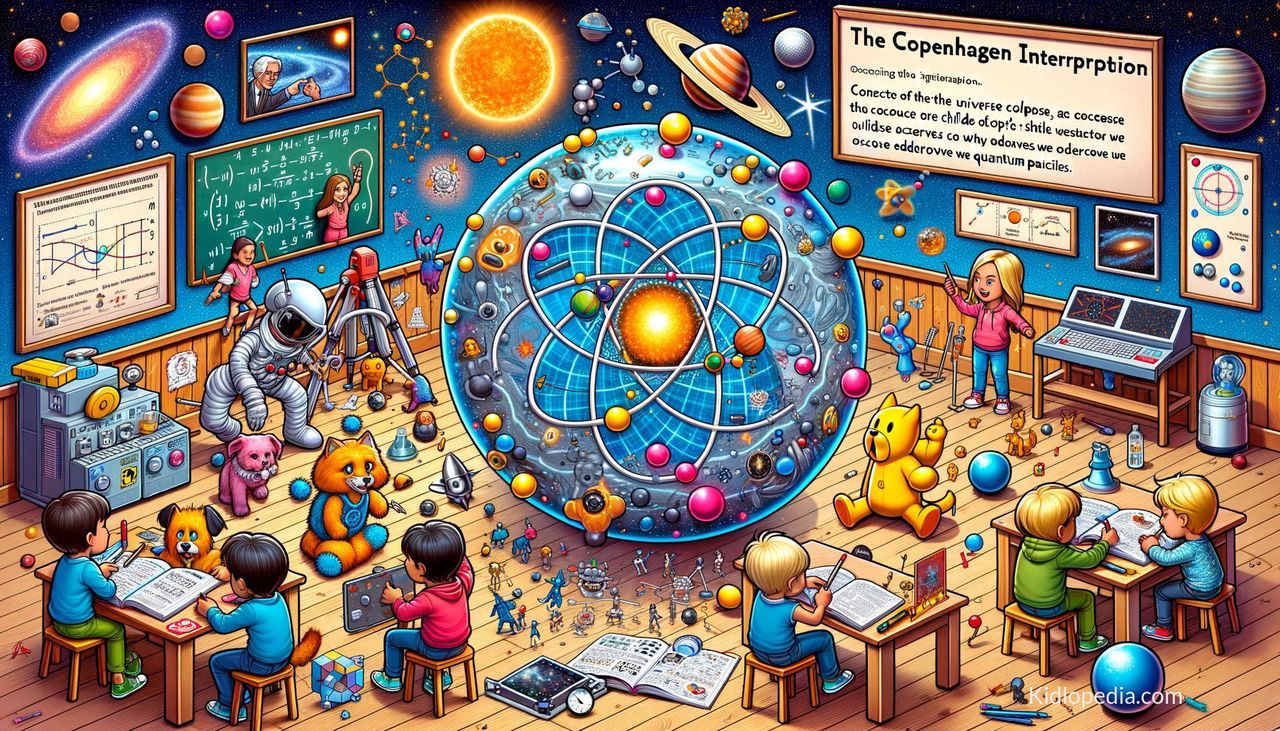
The Copenhagen Interpretation is a theory in quantum mechanics that explains how particles behave when they are observed. It suggests that quantum particles can exist in multiple states at once, but when we look at them, they "collapse" into a single state or position. This idea is important because it helps scientists understand the strange and complex nature of the tiny particles that make up our universe.
The Copenhagen Interpretation is a theory in quantum mechanics that explains how tiny particles behave when we observe them.
According to this theory, quantum particles can exist in many different states at the same time.
However, when we look closely at them, they "collapse" into one specific state or position.
This concept is important for understanding how the smallest parts of our universe work.
In the quantum world, particles such as electrons or photons can act like both waves and particles.
When no one is watching, they spread out and can be in many places at once, much like how a cloud can take many shapes.
But as soon as we try to measure or observe them, they decide on one position or path, just like a balloon that pops into a singular shape when you blow it up.
This idea helps scientists make sense of experiments that seem strange.
For example, if we were to shoot a particle through two openings, in theory, it can go through both at the same time.
But if we watch it go through, it will only take one path.
This shows how the act of looking changes what happens to the particle.
The Copenhagen Interpretation also implies that reality isn’t determined until we measure it.
This can feel confusing because we usually think things are in a certain way all the time.
However, in the quantum world, uncertainty is normal.
It’s part of what makes studying quantum mechanics so exciting and mysterious.
Did you know that the Copenhagen Interpretation was developed in the early 20th century by physicists like Niels Bohr and Werner Heisenberg?
Also, this interpretation is just one of many theories about quantum mechanics, and scientists are still exploring what it all means!
For more amazing facts and topics, visit Kidlopedia.com!
According to this theory, quantum particles can exist in many different states at the same time.
However, when we look closely at them, they "collapse" into one specific state or position.
This concept is important for understanding how the smallest parts of our universe work.
In the quantum world, particles such as electrons or photons can act like both waves and particles.
When no one is watching, they spread out and can be in many places at once, much like how a cloud can take many shapes.
But as soon as we try to measure or observe them, they decide on one position or path, just like a balloon that pops into a singular shape when you blow it up.
This idea helps scientists make sense of experiments that seem strange.
For example, if we were to shoot a particle through two openings, in theory, it can go through both at the same time.
But if we watch it go through, it will only take one path.
This shows how the act of looking changes what happens to the particle.
The Copenhagen Interpretation also implies that reality isn’t determined until we measure it.
This can feel confusing because we usually think things are in a certain way all the time.
However, in the quantum world, uncertainty is normal.
It’s part of what makes studying quantum mechanics so exciting and mysterious.
Did you know that the Copenhagen Interpretation was developed in the early 20th century by physicists like Niels Bohr and Werner Heisenberg?
Also, this interpretation is just one of many theories about quantum mechanics, and scientists are still exploring what it all means!
For more amazing facts and topics, visit Kidlopedia.com!