Exploding Stars: Supernovae
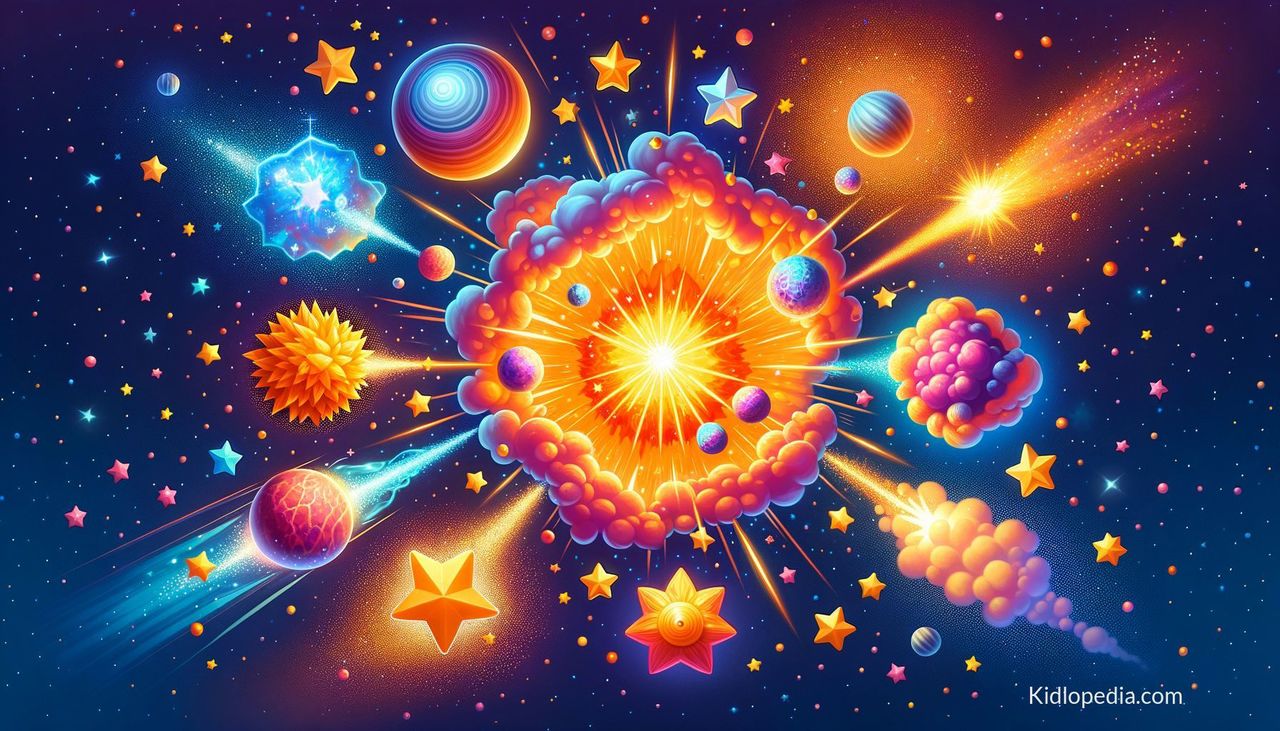
Supernovae are huge explosions that occur at the end of a star's life cycle. When a star exhausts its fuel, it can no longer hold itself up against gravity and dramatically bursts apart, releasing an enormous amount of energy and light. This process is important because it creates and spreads new elements across the universe, which can eventually form new stars, planets, and even life.
Supernovae are massive explosions that happen at the end of a star's life cycle.
When a star uses up all its fuel, it cannot hold itself against gravity.
This causes it to collapse and then burst apart dramatically.
The explosion releases a tremendous amount of energy and light, making supernovae some of the brightest events observed in the universe.
During a supernova, the star ejects its outer layers into space.
This material spreads out in all directions and can create shock waves.
These shock waves can compress nearby gas and dust, leading to the formation of new stars and planets.
The core of the star may also become a dense object, either a neutron star or a black hole, depending on the size of the original star.
Supernovae are important because they produce and distribute new elements throughout the universe.
When stars explode, they create elements like carbon, nitrogen, and iron.
These elements are essential for forming planets and even life.
The dust and gas from supernovae eventually mix with other materials in space, contributing to the building blocks of new stars and planets.
After a supernova, the remnants can be beautiful.
They often form colorful nebulae, which are clouds of gas and dust.
These nebulae can be where new stars are born, continuing the cycle of life in the universe.
Observing supernovae helps astronomers understand the life cycles of stars and the evolution of galaxies.
Did you know that supernovae can briefly outshine entire galaxies?
Also, the light from a supernova can take millions of years to reach Earth!
For more exciting topics about space and science, visit Kidlopedia.com!
When a star uses up all its fuel, it cannot hold itself against gravity.
This causes it to collapse and then burst apart dramatically.
The explosion releases a tremendous amount of energy and light, making supernovae some of the brightest events observed in the universe.
During a supernova, the star ejects its outer layers into space.
This material spreads out in all directions and can create shock waves.
These shock waves can compress nearby gas and dust, leading to the formation of new stars and planets.
The core of the star may also become a dense object, either a neutron star or a black hole, depending on the size of the original star.
Supernovae are important because they produce and distribute new elements throughout the universe.
When stars explode, they create elements like carbon, nitrogen, and iron.
These elements are essential for forming planets and even life.
The dust and gas from supernovae eventually mix with other materials in space, contributing to the building blocks of new stars and planets.
After a supernova, the remnants can be beautiful.
They often form colorful nebulae, which are clouds of gas and dust.
These nebulae can be where new stars are born, continuing the cycle of life in the universe.
Observing supernovae helps astronomers understand the life cycles of stars and the evolution of galaxies.
Did you know that supernovae can briefly outshine entire galaxies?
Also, the light from a supernova can take millions of years to reach Earth!
For more exciting topics about space and science, visit Kidlopedia.com!