Stars and Galaxies: Astronomy
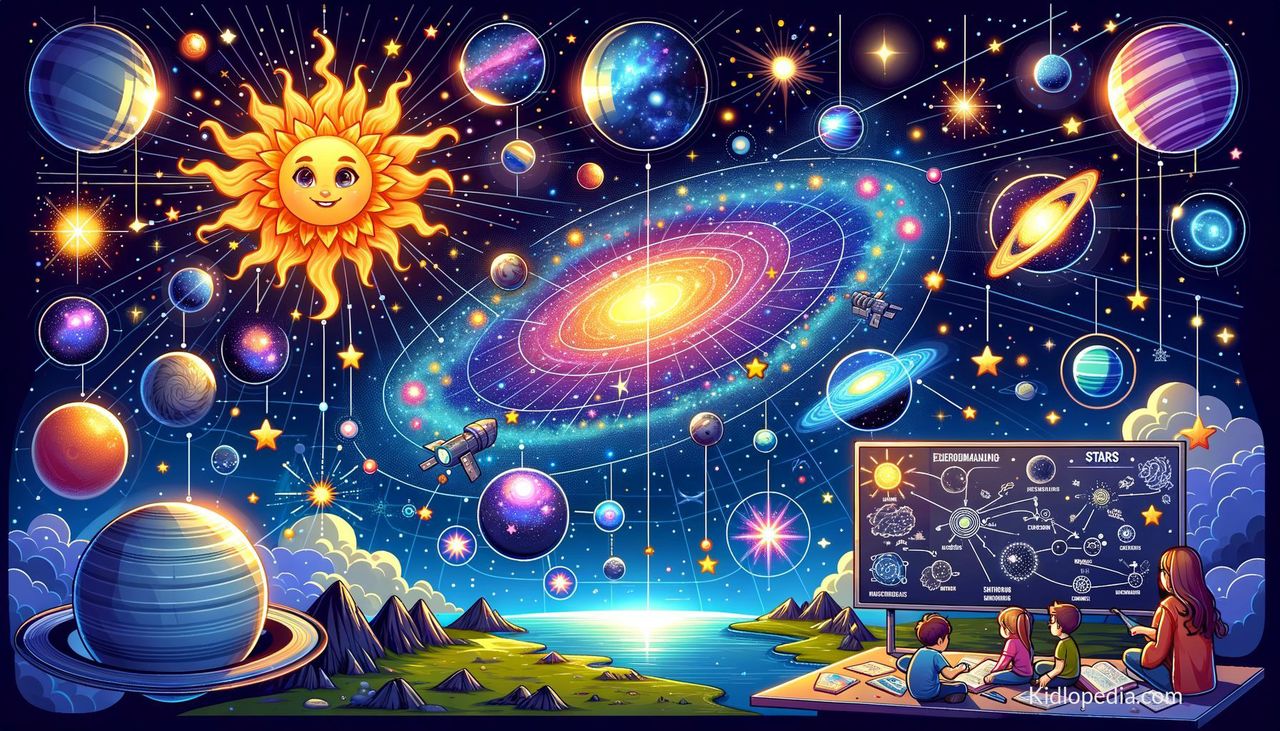
Stars are massive, glowing balls of gas that produce light and heat through nuclear fusion. They come in various sizes and types, from small red dwarfs to enormous blue giants. Galaxies are vast collections of stars, gas, dust, and dark matter, organized into different shapes, such as spiral, elliptical, and irregular forms, with the Milky Way being one of the most well-known galaxies.
Stars are massive, glowing balls of gas that generate light and heat through a process called nuclear fusion.
In the center of a star, hydrogen atoms combine to form helium, which releases a tremendous amount of energy.
This energy is what makes stars shine bright in the night sky.
Stars can vary greatly in size and color.
Some are small and cool, like red dwarfs, while others are much larger and hotter, like blue giants.
Galaxies are huge systems that contain millions or even billions of stars, along with gas, dust, and dark matter.
Galaxies are organized into different shapes, which include spiral, elliptical, and irregular forms.
The Milky Way is a spiral galaxy, and it is the galaxy that contains our Solar System.
Galaxies can be thought of as vast neighborhoods where stars live.
Stars are not evenly distributed across the universe.
Within a galaxy, stars are often grouped together in clusters.
Some of these clusters are very old, while others contain young, new stars.
The distance between stars in a galaxy can be vast, which means that even though there are many stars, they can be far apart.
When we look at the night sky, we see the light from stars that can be millions of light-years away.
This means that the light we see today may have started its journey to Earth long ago.
The study of stars and galaxies is called astronomy.
Astronomers use telescopes to learn more about these celestial bodies and to understand how the universe works.
Did you know?
There are more stars in the universe than there are grains of sand on all the Earth's beaches! Galaxies can collide and merge with each other, which helps them grow and change shape over time.
To learn more about stars, galaxies, and other exciting topics, visit Kidlopedia.com!
In the center of a star, hydrogen atoms combine to form helium, which releases a tremendous amount of energy.
This energy is what makes stars shine bright in the night sky.
Stars can vary greatly in size and color.
Some are small and cool, like red dwarfs, while others are much larger and hotter, like blue giants.
Galaxies are huge systems that contain millions or even billions of stars, along with gas, dust, and dark matter.
Galaxies are organized into different shapes, which include spiral, elliptical, and irregular forms.
The Milky Way is a spiral galaxy, and it is the galaxy that contains our Solar System.
Galaxies can be thought of as vast neighborhoods where stars live.
Stars are not evenly distributed across the universe.
Within a galaxy, stars are often grouped together in clusters.
Some of these clusters are very old, while others contain young, new stars.
The distance between stars in a galaxy can be vast, which means that even though there are many stars, they can be far apart.
When we look at the night sky, we see the light from stars that can be millions of light-years away.
This means that the light we see today may have started its journey to Earth long ago.
The study of stars and galaxies is called astronomy.
Astronomers use telescopes to learn more about these celestial bodies and to understand how the universe works.
Did you know?
There are more stars in the universe than there are grains of sand on all the Earth's beaches! Galaxies can collide and merge with each other, which helps them grow and change shape over time.
To learn more about stars, galaxies, and other exciting topics, visit Kidlopedia.com!