Star-Forming Regions: Nebulae
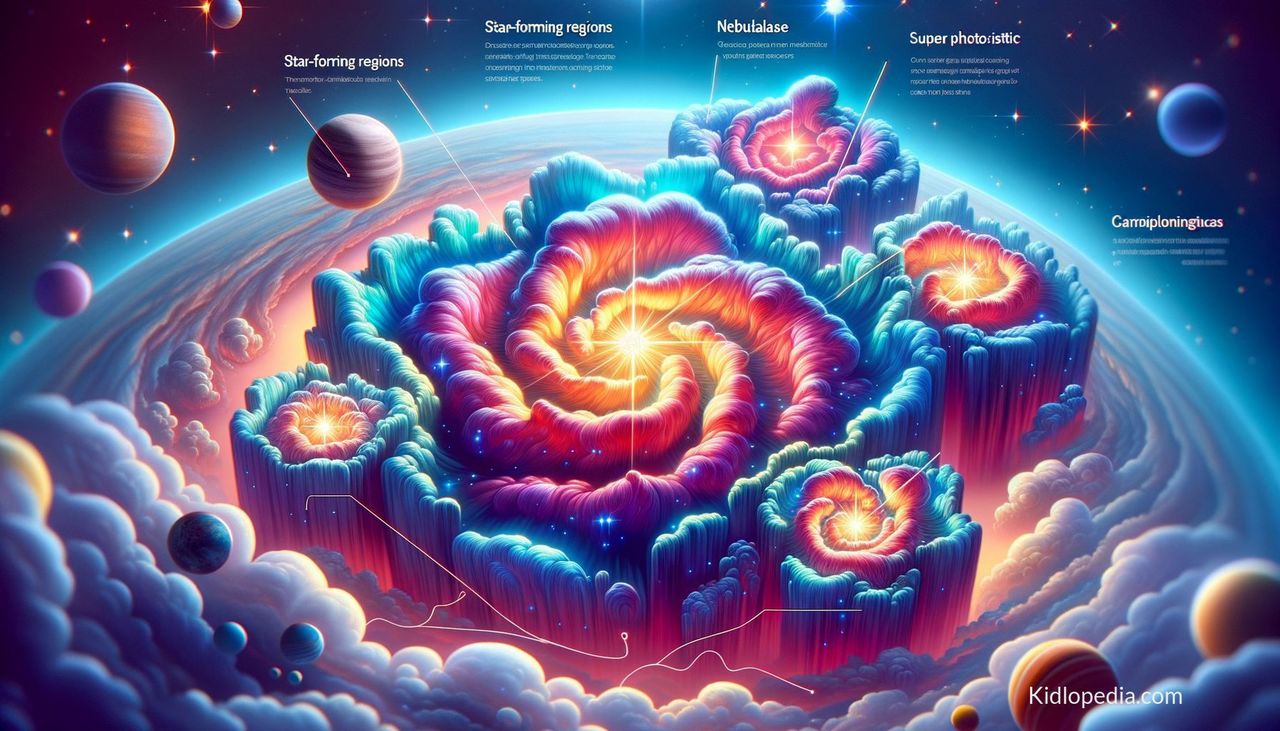
Nebulae are large clouds of gas and dust in space that serve as the birthplace for stars. They are often colorful due to different gases and can be found in various shapes and sizes. Understanding nebulae is important because they help astronomers learn how stars and solar systems form in the universe.
Nebulae are large clouds of gas and dust in space that serve as the birthplace for stars.
They are often colorful and can take on various shapes and sizes.
Some nebulae are formed from the remnants of old stars, while others are regions where new stars are beginning to form.
This process is important for the creation of stars and solar systems in the universe.
Inside a nebula, tiny particles of gas and dust come together due to gravity.
When enough material gathers, it begins to heat up.
As it gets hotter, the pressure increases, and this area becomes what is known as a protostar.
In this stage, the protostar is still forming and gathering more mass to eventually become a full-sized star.
As the protostar continues to grow, it reaches a point where nuclear fusion can begin.
This is when hydrogen atoms combine to form helium, releasing a tremendous amount of energy.
This energy makes the protostar shine brightly, and it becomes a star.
The surrounding material in the nebula may also clump together to form planets, moons, and other celestial bodies.
Nebulae are also interesting because they come in many colors.
The colors you see are due to different gases present in the nebula.
For example, hydrogen appears red, while oxygen can give a blue hue.
Each color tells us about the elements and conditions in that region of space.
Did you know that some nebulae can be millions of light-years across?
And did you know that the famous Orion Nebula is one of the closest star-forming regions to Earth, located about 1,344 light-years away?
Explore more fascinating topics at Kidlopedia.com!
They are often colorful and can take on various shapes and sizes.
Some nebulae are formed from the remnants of old stars, while others are regions where new stars are beginning to form.
This process is important for the creation of stars and solar systems in the universe.
Inside a nebula, tiny particles of gas and dust come together due to gravity.
When enough material gathers, it begins to heat up.
As it gets hotter, the pressure increases, and this area becomes what is known as a protostar.
In this stage, the protostar is still forming and gathering more mass to eventually become a full-sized star.
As the protostar continues to grow, it reaches a point where nuclear fusion can begin.
This is when hydrogen atoms combine to form helium, releasing a tremendous amount of energy.
This energy makes the protostar shine brightly, and it becomes a star.
The surrounding material in the nebula may also clump together to form planets, moons, and other celestial bodies.
Nebulae are also interesting because they come in many colors.
The colors you see are due to different gases present in the nebula.
For example, hydrogen appears red, while oxygen can give a blue hue.
Each color tells us about the elements and conditions in that region of space.
Did you know that some nebulae can be millions of light-years across?
And did you know that the famous Orion Nebula is one of the closest star-forming regions to Earth, located about 1,344 light-years away?
Explore more fascinating topics at Kidlopedia.com!