The Universe's Projection: The Holographic Principle
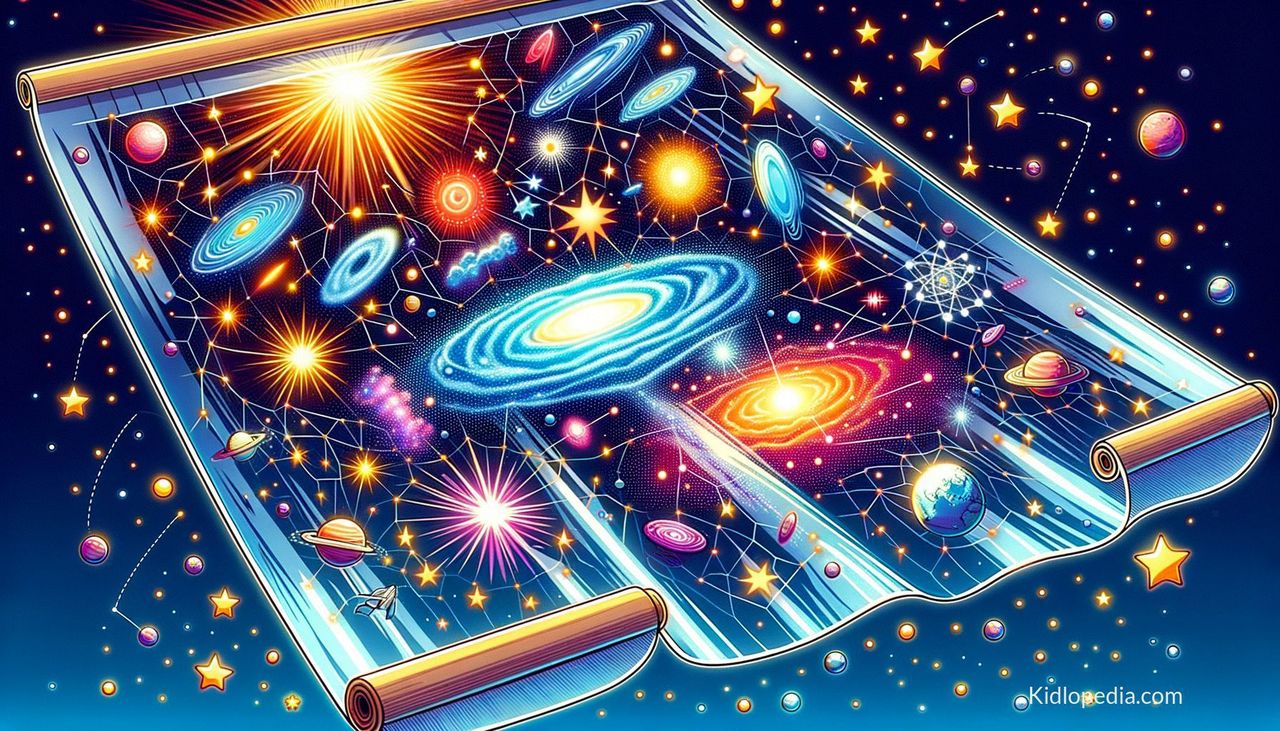
The Holographic Principle is a theory in science that suggests the universe might be like a hologram, where all the information about our three-dimensional world is stored on a two-dimensional surface. This means that what we perceive as solid objects could actually be made of tiny bits of energy and light. Understanding this principle helps scientists learn more about the nature of reality and the universe we live in.
The Holographic Principle is a scientific theory that suggests our universe might work like a hologram.
A hologram is an image that looks three-dimensional but is actually created from light and patterns on a flat surface.
According to this principle, all the information that makes up our three-dimensional world is stored on a two-dimensional surface, kind of like a special kind of film.
In the universe, we see solid objects like rocks, trees, and even ourselves.
However, at a deeper level, these objects are made up of tiny bits of energy and light.
Light and energy are fundamental building blocks of everything around us.
This means what we touch and see could be more like patterns of information than solid things.
Scientists are still exploring the Holographic Principle to understand how our universe works.
It helps them think about the nature of reality.
For example, if our universe is like a hologram, it could change how we think about space and time.
It opens up many questions about existence and what is real.
Experiments and observations support the idea that the universe behaves in strange ways.
One interesting aspect is how black holes might store information about everything that falls into them in a two-dimensional way.
This means the universe might be much more complicated and amazing than we can see.
Did you know?
Some scientists say the entire universe could be described using a set of instructions written on a two-dimensional surface! Also, other examples of holography can be seen in credit cards and some artworks, where images appear to be three-dimensional.
Explore more exciting topics at Kidlopedia.com!
A hologram is an image that looks three-dimensional but is actually created from light and patterns on a flat surface.
According to this principle, all the information that makes up our three-dimensional world is stored on a two-dimensional surface, kind of like a special kind of film.
In the universe, we see solid objects like rocks, trees, and even ourselves.
However, at a deeper level, these objects are made up of tiny bits of energy and light.
Light and energy are fundamental building blocks of everything around us.
This means what we touch and see could be more like patterns of information than solid things.
Scientists are still exploring the Holographic Principle to understand how our universe works.
It helps them think about the nature of reality.
For example, if our universe is like a hologram, it could change how we think about space and time.
It opens up many questions about existence and what is real.
Experiments and observations support the idea that the universe behaves in strange ways.
One interesting aspect is how black holes might store information about everything that falls into them in a two-dimensional way.
This means the universe might be much more complicated and amazing than we can see.
Did you know?
Some scientists say the entire universe could be described using a set of instructions written on a two-dimensional surface! Also, other examples of holography can be seen in credit cards and some artworks, where images appear to be three-dimensional.
Explore more exciting topics at Kidlopedia.com!