The Ultimate Theory: M-Theory
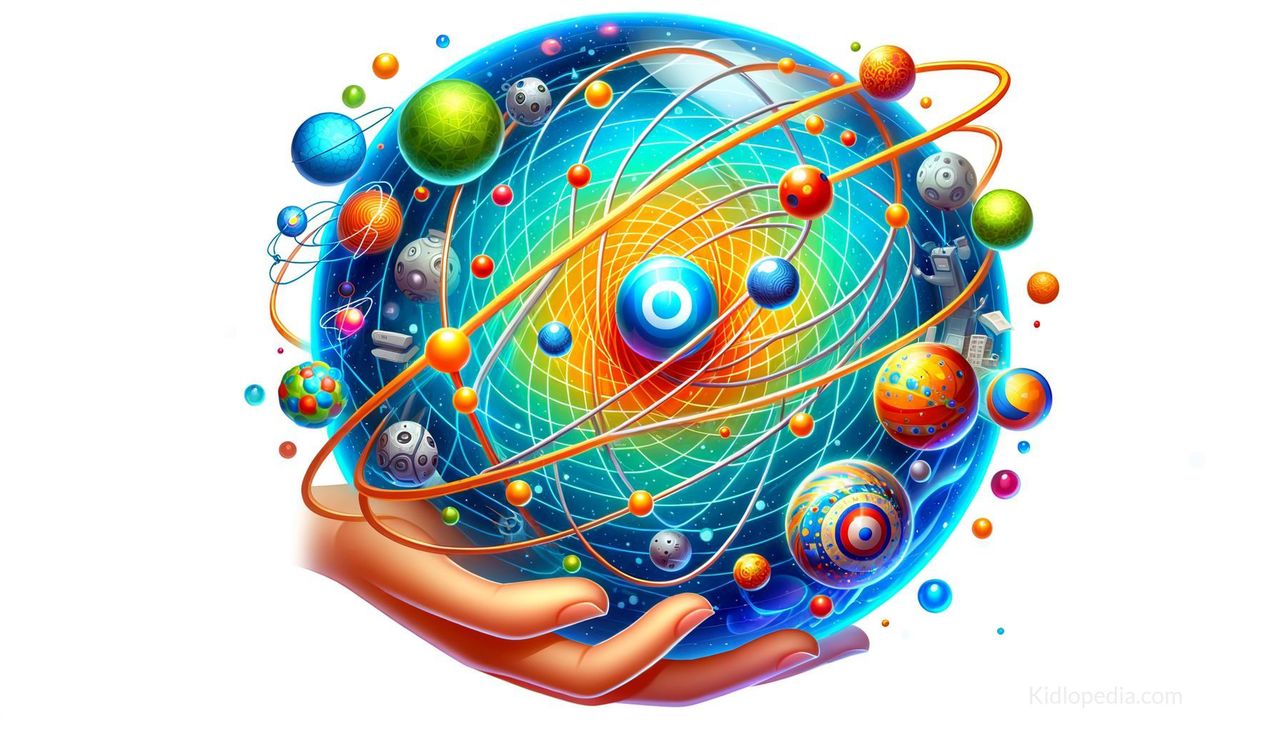
M-Theory is a scientific explanation that suggests the universe is made up of tiny vibrating strings. These strings can create all the particles in the universe, making everything we see and don't see. Understanding M-Theory helps scientists explore how different forces and dimensions are connected in the universe.
M-Theory is a scientific explanation that suggests the universe is made up of tiny, vibrating strings.
These strings can create all the particles that make up everything we see around us, from stars in the sky to the air we breathe.
M-Theory combines several ideas from physics to help explain how the universe works on a very small scale.
In M-Theory, these strings are extremely small, much smaller than atoms.
They vibrate in different ways, and their vibrations determine what type of particle they will become.
For example, one vibration might create an electron, while another vibration might create a quark.
Quarks are the building blocks of protons and neutrons, which are found in the nuclei of atoms.
M-Theory also helps scientists understand the different forces in the universe, such as gravity and electromagnetism.
When strings vibrate, they can interact with each other.
This interaction is what keeps everything in the universe connected.
Think of it like a web where every part is linked, and if one part moves, it can affect the others.
Another interesting aspect of M-Theory is that it suggests there might be additional dimensions beyond the three we can see.
We experience the universe in three dimensions: length, width, and height.
However, M-Theory proposes that there are hidden dimensions that we cannot directly experience.
These extra dimensions help explain how strings can move and vibrate, creating the different particles we observe.
Did you know that scientists are still trying to discover more about M-Theory?
It is considered a leading candidate for a "theory of everything," which means it could explain all the forces and particles in the universe!
For more exciting topics, visit Kidlopedia.com!
These strings can create all the particles that make up everything we see around us, from stars in the sky to the air we breathe.
M-Theory combines several ideas from physics to help explain how the universe works on a very small scale.
In M-Theory, these strings are extremely small, much smaller than atoms.
They vibrate in different ways, and their vibrations determine what type of particle they will become.
For example, one vibration might create an electron, while another vibration might create a quark.
Quarks are the building blocks of protons and neutrons, which are found in the nuclei of atoms.
M-Theory also helps scientists understand the different forces in the universe, such as gravity and electromagnetism.
When strings vibrate, they can interact with each other.
This interaction is what keeps everything in the universe connected.
Think of it like a web where every part is linked, and if one part moves, it can affect the others.
Another interesting aspect of M-Theory is that it suggests there might be additional dimensions beyond the three we can see.
We experience the universe in three dimensions: length, width, and height.
However, M-Theory proposes that there are hidden dimensions that we cannot directly experience.
These extra dimensions help explain how strings can move and vibrate, creating the different particles we observe.
Did you know that scientists are still trying to discover more about M-Theory?
It is considered a leading candidate for a "theory of everything," which means it could explain all the forces and particles in the universe!
For more exciting topics, visit Kidlopedia.com!