The Universe's Compression: The Blueshift
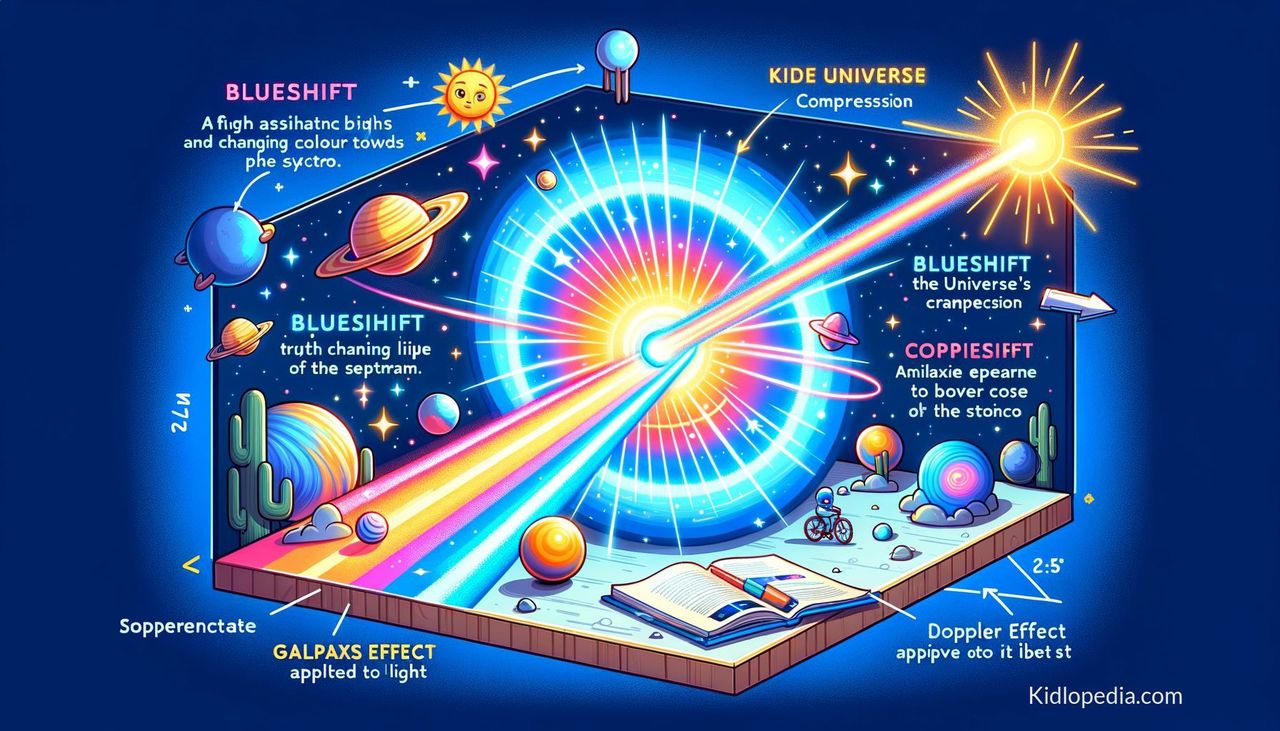
Blueshift is a phenomenon that occurs when a star or galaxy moves toward us, causing its light to appear bluer than it actually is. This happens because the waves of light get compressed, similar to how a sound gets higher in pitch when something is approaching. Understanding blueshift is important for scientists, as it helps them learn how the universe is expanding and how celestial objects are moving.
Blueshift is a phenomenon that occurs when a star or galaxy moves toward us, causing its light to look bluer than it really is.
This happens because the light waves get compressed.
It is similar to how sound waves change when an object moves closer to us.
For example, when a car approaches with its horn sounding, the pitch of the sound appears higher.
This is called the Doppler Effect, and blueshift is the same idea applied to light.
When a star or galaxy moves closer, its light waves are squeezed together.
This compression makes the light shift to the blue end of the spectrum.
The blue color we see is not because the light is actually changing color but because of the movement of the object.
Light from objects moving away from us appears redder, in a phenomenon called redshift.
Scientists observe blueshift to learn about the movement of stars and galaxies in the universe.
By measuring the amount of shift in the light's color, they can determine how fast an object is moving toward us.
This information helps astronomers understand the structure and evolution of the universe.
Blueshift is important for understanding the universe's expansion.
It tells us which celestial objects are getting closer, helping us piece together the cosmic puzzle.
Tracking the movement of these stars and galaxies is like observing a grand dance across the universe.
Did you know?
Some stars are moving toward us at such high speeds that their light is greatly shifted into the blue spectrum.
Scientists use these measurements to learn more about the universe's history and future.
Also, not all stars are moving away; some are closing in on us right now!
Explore more fascinating topics at Kidlopedia.com!
This happens because the light waves get compressed.
It is similar to how sound waves change when an object moves closer to us.
For example, when a car approaches with its horn sounding, the pitch of the sound appears higher.
This is called the Doppler Effect, and blueshift is the same idea applied to light.
When a star or galaxy moves closer, its light waves are squeezed together.
This compression makes the light shift to the blue end of the spectrum.
The blue color we see is not because the light is actually changing color but because of the movement of the object.
Light from objects moving away from us appears redder, in a phenomenon called redshift.
Scientists observe blueshift to learn about the movement of stars and galaxies in the universe.
By measuring the amount of shift in the light's color, they can determine how fast an object is moving toward us.
This information helps astronomers understand the structure and evolution of the universe.
Blueshift is important for understanding the universe's expansion.
It tells us which celestial objects are getting closer, helping us piece together the cosmic puzzle.
Tracking the movement of these stars and galaxies is like observing a grand dance across the universe.
Did you know?
Some stars are moving toward us at such high speeds that their light is greatly shifted into the blue spectrum.
Scientists use these measurements to learn more about the universe's history and future.
Also, not all stars are moving away; some are closing in on us right now!
Explore more fascinating topics at Kidlopedia.com!