The Universe's Quarks: Quantum Chromodynamics
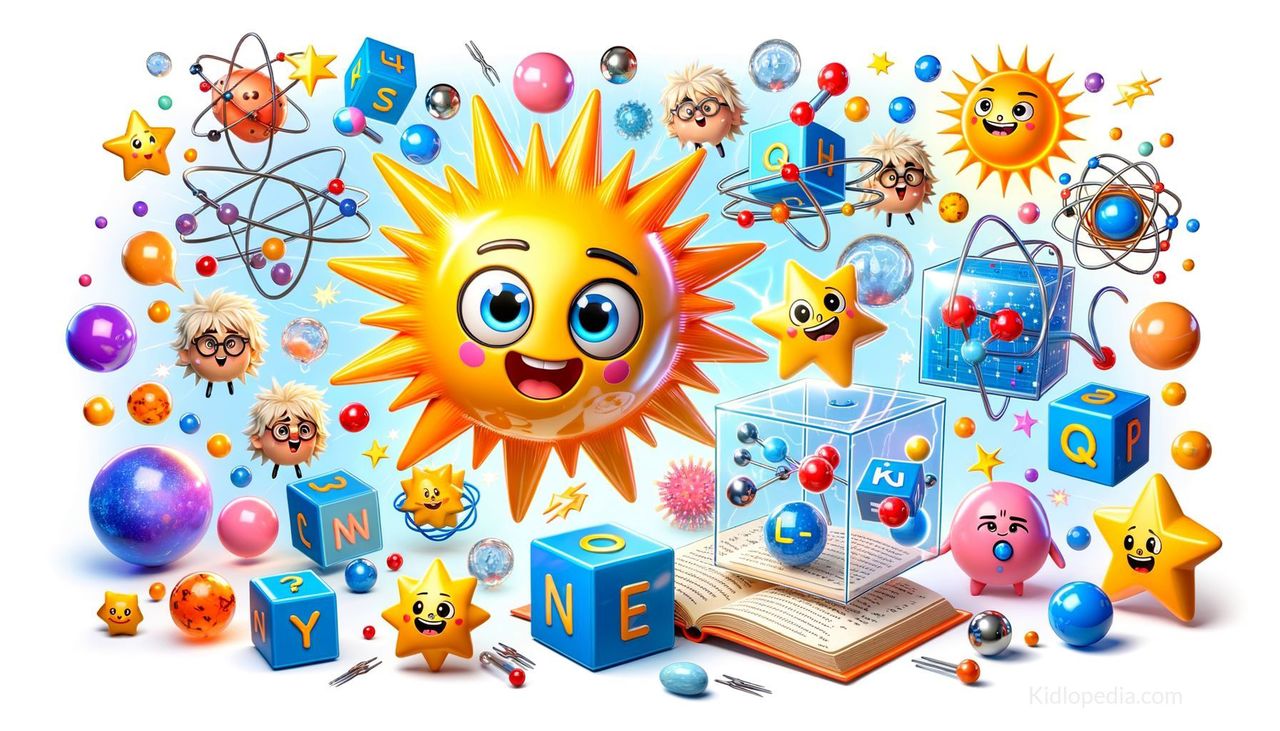
Quarks are tiny particles that are essential building blocks of matter. They combine in groups to form protons and neutrons, which make up the nucleus of atoms. Quarks have a property known as "color charge," and they interact through a force called Quantum Chromodynamics, which helps them stick together to create everything we see in the universe.
Quarks are tiny particles that are fundamental building blocks of matter.
They are so small that you cannot see them with your eyes or even with normal microscopes.
Quarks combine in groups to form protons and neutrons, which make up the nucleus of atoms.
Atoms are the basic units of elements and everything around us is made up of atoms.
Quarks have a special property called "color charge." This does not refer to colors we can see, like red or blue, but is a way to describe how quarks interact.
There are three types of color charges: red, green, and blue.
Quarks with different color charges can combine to form particles.
When quarks join together, they form groups that are called hadrons.
The force that holds quarks together is known as Quantum Chromodynamics, or QCD for short.
You can think of QCD like a strong glue that keeps the quarks in a proton or neutron together.
Quarks cannot exist alone; they must always be in groups.
For example, a proton consists of two up quarks and one down quark, while a neutron consists of one up quark and two down quarks.
Quarks can change their color charge through particles called gluons.
Gluons act like messengers that help quarks exchange their color charges.
This process allows quarks to stay connected even as they change their colors, making sure they never have to be alone.
Did you know that quarks are so tiny that they are considered to be point particles, meaning they do not have size?
Also, without quarks, there would be no matter in the universe!
Keep exploring more exciting topics at Kidlopedia.com!
They are so small that you cannot see them with your eyes or even with normal microscopes.
Quarks combine in groups to form protons and neutrons, which make up the nucleus of atoms.
Atoms are the basic units of elements and everything around us is made up of atoms.
Quarks have a special property called "color charge." This does not refer to colors we can see, like red or blue, but is a way to describe how quarks interact.
There are three types of color charges: red, green, and blue.
Quarks with different color charges can combine to form particles.
When quarks join together, they form groups that are called hadrons.
The force that holds quarks together is known as Quantum Chromodynamics, or QCD for short.
You can think of QCD like a strong glue that keeps the quarks in a proton or neutron together.
Quarks cannot exist alone; they must always be in groups.
For example, a proton consists of two up quarks and one down quark, while a neutron consists of one up quark and two down quarks.
Quarks can change their color charge through particles called gluons.
Gluons act like messengers that help quarks exchange their color charges.
This process allows quarks to stay connected even as they change their colors, making sure they never have to be alone.
Did you know that quarks are so tiny that they are considered to be point particles, meaning they do not have size?
Also, without quarks, there would be no matter in the universe!
Keep exploring more exciting topics at Kidlopedia.com!