WHAT IS SPACE TRAVEL?
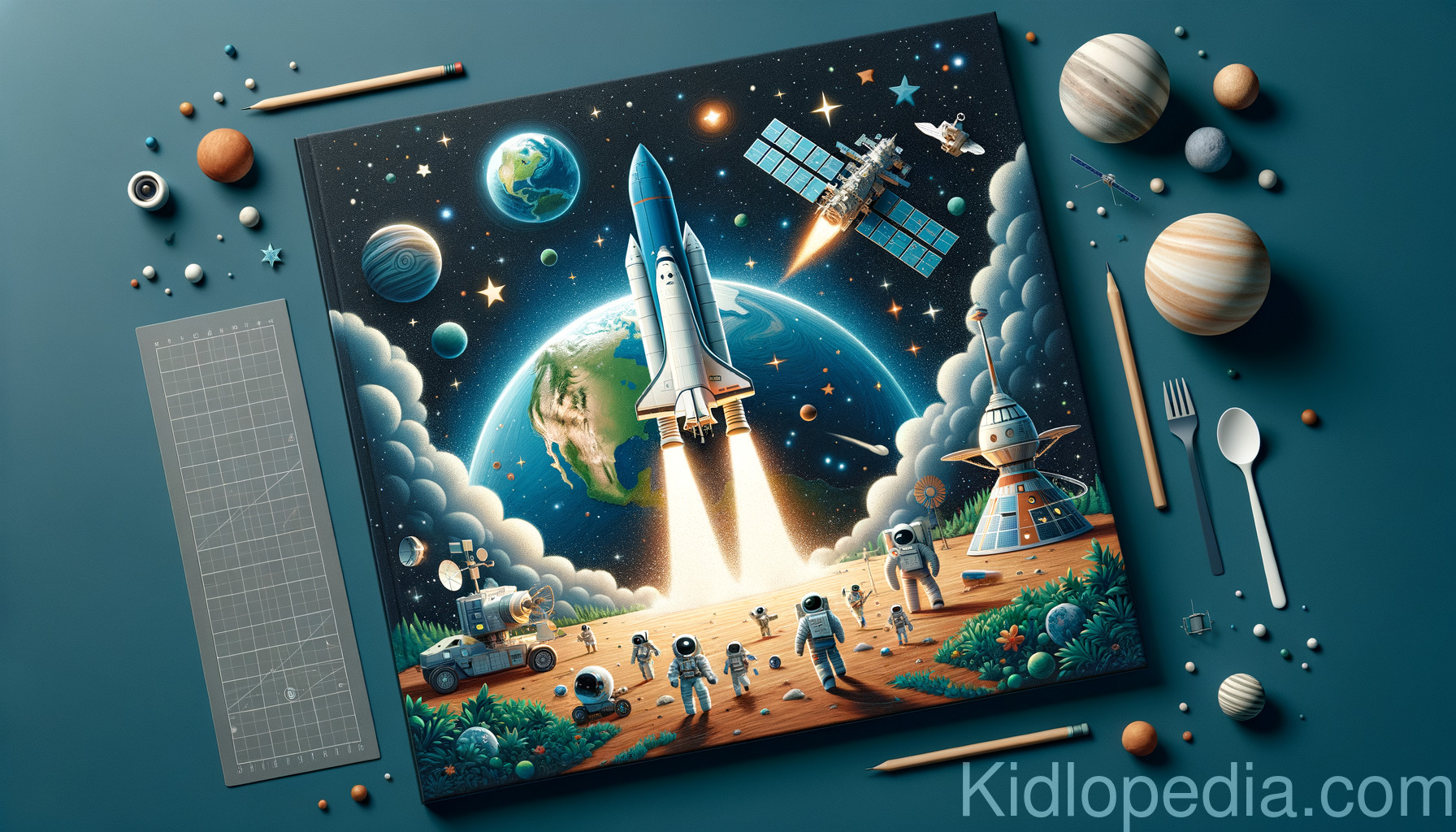
Space travel is when humans or machines leave Earth to explore outer space. It allows us to study planets, stars, and the universe, helping to expand our knowledge and understanding of the cosmos. Since its beginning with rockets and satellites, space travel has advanced to include astronauts living in space stations and probes reaching distant worlds.
Space travel is when humans or machines leave Earth to explore space.
It allows us to learn about planets, stars, and the entire universe.
Space travel provides important information that helps scientists understand where we live and what exists beyond our planet.
Space travel started with rockets.
A rocket is a vehicle that uses powerful engines to push itself into the sky.
The first successful rocket was launched in the 20th century.
After rockets, satellites were created.
Satellites orbit Earth, and they help us communicate, predict weather, and study our planet from above.
Today, astronauts can live and work in space.
They stay in special buildings called space stations.
The International Space Station (ISS) is one of the most well-known space stations.
It orbits Earth and is home to astronauts from different countries.
They conduct experiments and learn how living in space affects the human body.
In addition to astronauts, we also use unmanned machines called probes.
Probes travel to distant planets and send back information.
For example, the Mars rovers explore the surface of Mars and take pictures.
They help scientists learn about the conditions on other planets.
Space travel not only helps us understand the universe, but it also teaches us about Earth.
We learn about our planet's climate, resources, and the way it fits into the larger universe.
Did you know that the first human in space was Yuri Gagarin in 1961?
Also, Voyager 1, launched in 1977, is the farthest human-made object from Earth!
If you want to explore more exciting topics, visit Kidlopedia.com!
It allows us to learn about planets, stars, and the entire universe.
Space travel provides important information that helps scientists understand where we live and what exists beyond our planet.
Space travel started with rockets.
A rocket is a vehicle that uses powerful engines to push itself into the sky.
The first successful rocket was launched in the 20th century.
After rockets, satellites were created.
Satellites orbit Earth, and they help us communicate, predict weather, and study our planet from above.
Today, astronauts can live and work in space.
They stay in special buildings called space stations.
The International Space Station (ISS) is one of the most well-known space stations.
It orbits Earth and is home to astronauts from different countries.
They conduct experiments and learn how living in space affects the human body.
In addition to astronauts, we also use unmanned machines called probes.
Probes travel to distant planets and send back information.
For example, the Mars rovers explore the surface of Mars and take pictures.
They help scientists learn about the conditions on other planets.
Space travel not only helps us understand the universe, but it also teaches us about Earth.
We learn about our planet's climate, resources, and the way it fits into the larger universe.
Did you know that the first human in space was Yuri Gagarin in 1961?
Also, Voyager 1, launched in 1977, is the farthest human-made object from Earth!
If you want to explore more exciting topics, visit Kidlopedia.com!