About and helpSkip to discoveries
Kidlopedia — Encyclopedia for kidsKids First Class · Bach Foundation

Explore topics

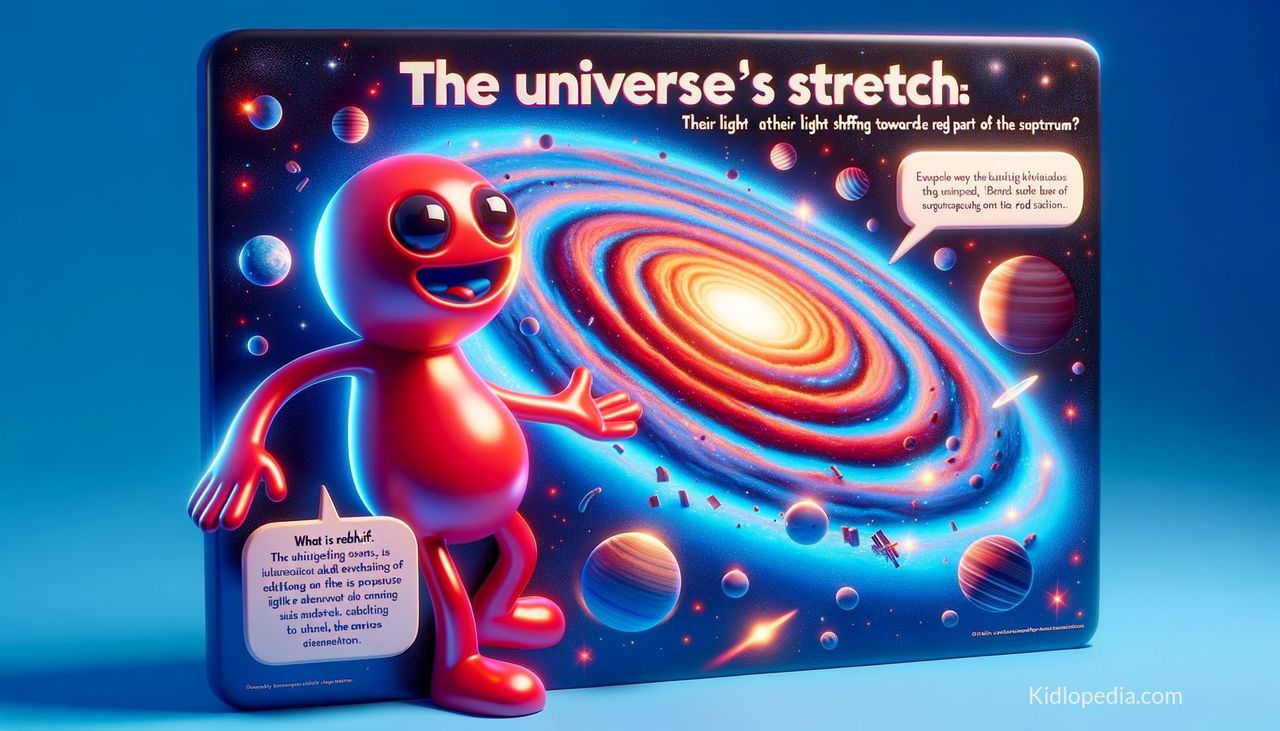
The Universe's Stretch: The Redshift

The Universe's Stretch: The Redshift

Redshift is a phenomenon that occurs when light from stars and galaxies shifts to longer wavelengths, toward the red end of the spectrum or beyond. For distant galaxies, the main cause is the expansion of the universe, which stretches the light waves as they travel to us. Movement through space can also cause redshift. Using a model of cosmic expansion, scientists can use cosmological redshift to estimate distances to faraway galaxies and learn about the universe.

Where Are the Aliens?: The Fermi Paradox

Where Are the Aliens?: The Fermi Paradox

The Fermi Paradox asks why, despite the vastness and age of the universe and the many planets where life might develop, we have not yet found confirmed evidence of alien civilizations. It highlights the contrast between the possibility of many extraterrestrial civilizations with advanced technology and the lack of confirmed signs of them. We do not yet know how common life or civilizations are beyond Earth. Understanding this paradox encourages us to think about the universe, the conditions necessary for life, and what it means to search for others among the stars.

The Subatomic World: The Quantum Universe

The Subatomic World: The Quantum Universe

Quantum physics is the branch of science that studies the behavior of the smallest particles in the universe, like atoms and subatomic particles. It explores how these tiny particles interact, move, and exist in ways that can seem strange and surprising compared to our everyday experiences. Understanding quantum physics is important because it helps scientists explain how matter and energy work at a fundamental level, which is essential for the development of new technologies and innovations.

The Universe's Diversity: The Anthropic Multiverse

The Universe's Diversity: The Anthropic Multiverse

The Anthropic Multiverse is the idea that there are many different universes, each with its own unique properties and laws of nature. This concept helps scientists understand why our universe has the specific conditions that allow life to exist, suggesting that if other universes exist, they might have different rules that could support different forms of life. Exploring the Anthropic Multiverse encourages curiosity and opens up possibilities about what else might exist beyond our own universe.

The Universe's Collapse: The Copenhagen Interpretation

The Universe's Collapse: The Copenhagen Interpretation

The Universe's Collapse: The Copenhagen Interpretation The Copenhagen Interpretation is a theory in quantum mechanics that explains how particles behave when they are observed. It suggests that quantum particles can exist in multiple states at once, but when we look at them, they "collapse" into a single state or position. This idea is important because it helps scientists understand the strange and complex nature of the tiny particles that make up our universe.

Explore topics