About and helpSkip to discoveries
Kidlopedia — Encyclopedia for kidsKids First Class · Bach Foundation

Explore topics

The Universe's Rules: Quantum Mechanics

The Universe's Rules: Quantum Mechanics

Quantum mechanics is the branch of physics that studies the behavior of very small particles, like atoms and photons. It reveals fascinating rules, such as superposition, where particles can exist in multiple states at once, and entanglement, where particles can be connected over distances. Understanding these rules helps scientists explain how the universe operates at its most fundamental level, leading to advancements in technology and our knowledge of the natural world.

The Universe's Connections: Quantum Entanglement

The Universe's Connections: Quantum Entanglement

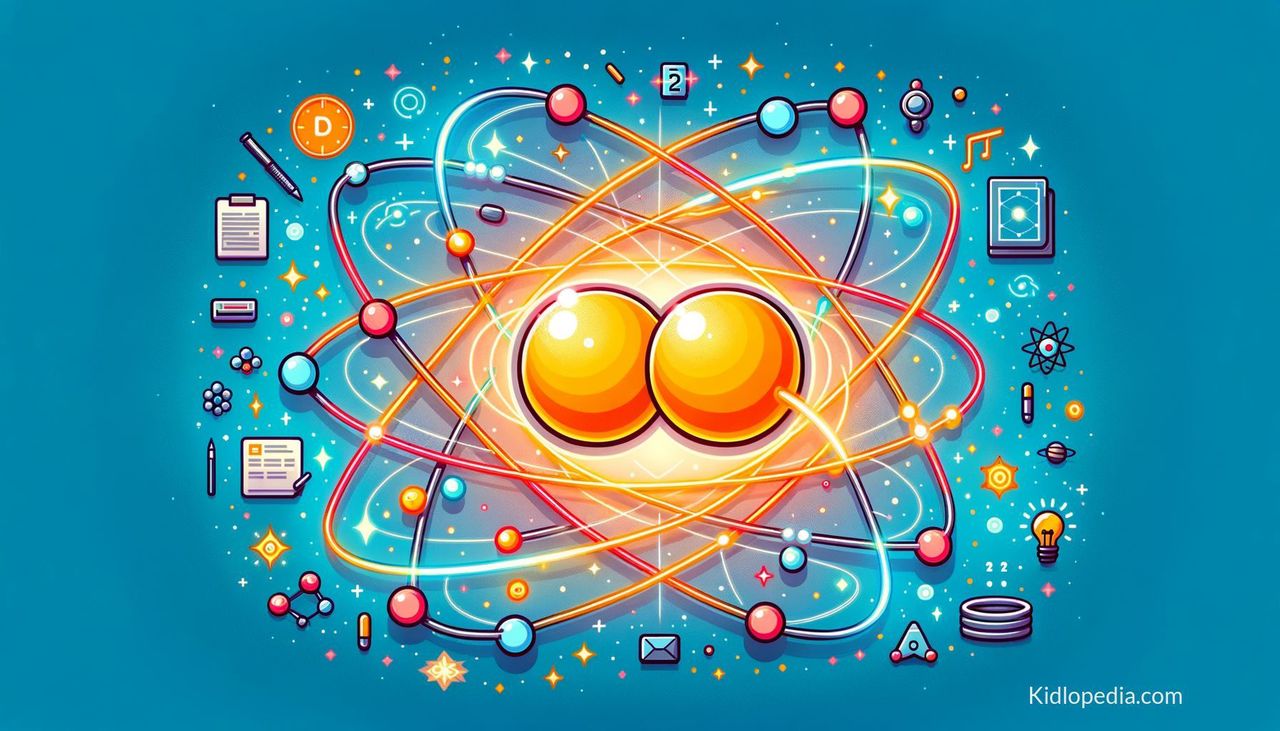
Quantum entanglement is a phenomenon in physics where two or more particles become linked in such a way that the state of one particle instantly affects the state of the other, regardless of the distance between them. This connection happens at a microscopic level and is important in understanding the nature of particles and forces in the universe. Studying quantum entanglement helps scientists explore the foundations of quantum mechanics and could lead to advancements in technology like quantum computing and secure communication.

The Universe's Processing: Quantum Computation

The Universe's Processing: Quantum Computation

Quantum computation is a method of computing that uses the principles of quantum mechanics, which is the science that studies tiny particles like atoms and photons. Quantum computers use special pieces of information called Q-bits, which can represent both 0 and 1 at the same time, allowing them to analyze many possibilities simultaneously. This ability helps quantum computers solve complex problems much faster than traditional computers, making them important for advancements in technology and science.

All 54 discoveries are shown.

Explore topics